



.svg)



.svg)


.svg)


Getting your HubSpot account live is one thing. Getting your team to actually use it, and see results, is another. This guide walks you through the complete HubSpot onboarding process, from pre-kickoff preparation to post-launch optimization, so your 2026 rollout delivers real ROI instead of becoming another underused CRM.
What HubSpot Onboarding Actually Is (and Why It Matters in 2026)
HubSpot onboarding is a structured 30-90 day project designed to configure your CRM, migrate your data, and train your team for consistent daily usage, which is what a HubSpot implementation service delivers end-to-end. It’s not just about activating your HubSpot portal, it’s about aligning the platform with how your business actually operates. Structured onboarding helps flatten the learning curve for new users, enabling your team to become proficient with HubSpot more quickly and adopt the platform with fewer obstacles.
The onboarding process typically covers the Marketing Hub, Sales Hub, and Service Hub alongside the CRM core. Depending on your tech stack, you may also include CMS Hub for website pages and Operations Hub for data synchronization.
The goal is concrete: tie your HubSpot setup to measurable business goals like “increase MQLs by 30% by Q4 2026” or “reduce sales cycle from 45 to 30 days.”
Here’s what HubSpot onboarding includes:
- Configuring hubs (marketing sales and service) to match your current processes
- Migrating and cleaning existing contacts from legacy systems
- Setting up automation workflows for lead nurturing and ticket pipelines
- Training users on daily tasks specific to their roles
- Building dashboards tied to your performance metrics
- Preparing for AI-driven features like Breeze AI for lead qualification
Reports suggest a 70% failure rate for unstructured HubSpot implementations. A structured onboarding prevents your HubSpot investment from becoming shelfware.
Key Benefits of a Structured HubSpot Onboarding
A structured onboarding framework accelerates your return on investment, drives user adoption, and ensures data quality from day one. Instead of spending 6–12 months “figuring things out,” your team can see value within the first 30–60 days.
Here’s what a proper onboarding experience delivers:
- Faster time-to-value with clear weekly milestones
- Higher user adoption through role-specific training sessions
- Better automation that actually reflects your sales process
- Cleaner reporting without duplicate contacts or missing fields
- Reduced risk of costly rework or data loss
- Cross-team alignment between marketing sales and service teams
Effective HubSpot marketing onboarding or sales onboarding ensures your team gains maximum advantage by utilizing the platform’s full range of features for optimal business growth. This approach empowers users to fully leverage HubSpot’s capabilities and drive better results. Elefante's HubSpot onboarding services tailor the platform to your business so your teams can adopt HubSpot quickly and get the most value from every feature.
Faster Return on Investment (ROI)
Having clear onboarding milestones, weeks 1–4 focused on foundations, weeks 5–8 on training and launch, compresses your path to ROI.
- Enable lead capture forms and basic nurture campaigns in the first 30 days to start generating leads immediately
- Launch your first marketing email sequences by week 4 to begin pipeline development
- See first campaign-sourced opportunities within 60 days when lead generation tools are properly configured
By leveraging automation and professional onboarding assistance, companies can save time during setup, data migration, and initial training, allowing teams to focus on achieving results sooner.
Companies that establish this cadence report generating more deals in their first quarter than those who take an ad-hoc approach over six months.
Higher User Adoption and Confidence
Generic platform walkthroughs don’t cut it. Structured onboarding includes role-specific training for your sales team, marketers, and service agents.
Effective training formats include:
- Live sessions covering daily workflows (logging calls, updating deals, managing tickets)
- Recorded Loom videos for asynchronous learning and refreshers
- Internal playbooks created during onboarding that match your specific business processes
Early wins matter. When your sales team sees a simplified deal pipeline working within the first month, resistance drops and confidence builds. This momentum carries through the entire rollout.
Stronger Automation and Cleaner Data
Onboarding focuses on setting up core workflows first rather than trying to automate everything at once:
- Lead capture → nurture → handoff to sales
- Ticket creation → triage → close
- Demo request → qualification → assignment
Proper property design and data mapping during onboarding prevents duplicate contacts and unreliable dashboards. For example, when migrating from Pipedrive or Salesforce, establishing deduplication rules based on email domains and unique IDs ensures contacts don’t appear multiple times, saving your team from inaccurate reporting and wasted outreach.
How Long Does HubSpot Onboarding Take (30, 60, and 90-Day Paths)
Typical HubSpot onboarding services range from 30 days for simple setups to 90+ days for enterprise deployments. Most small-to-medium businesses land in the 60-day range.
Complexity depends on:
- Number of hubs activated (Marketing, Sales, Service, CMS, Operations)
- Volume of existing contacts and historical data
- Number of integrations (Salesforce, Shopify, Zendesk, Slack)
- User count and permission requirements
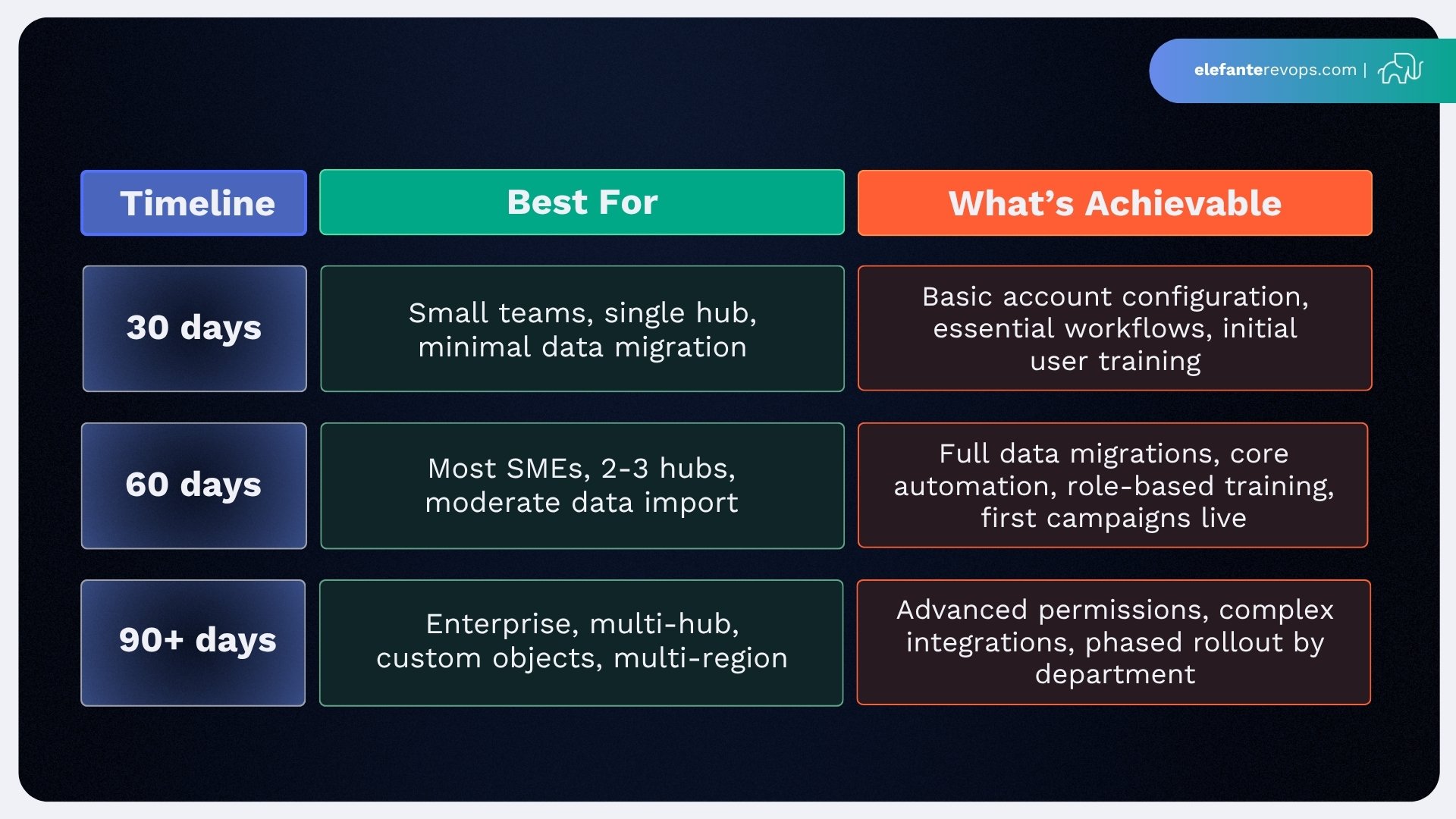
Professional-tier single-hub setups typically take 6–8 weeks. Complex migrations extend to 8–10 weeks. Enterprise multi-hub scenarios require scoped per-hub phasing.
Preparing for HubSpot Onboarding Before Day 1
The most successful onboardings start preparation 2–4 weeks before the official kickoff call. This pre-work dramatically accelerates what you can accomplish in week one.
Preparation checklist:
- Select internal stakeholders from each team (marketing, sales, service, operations/IT)
- Clean existing data: remove obvious duplicates, standardize formats, export only relevant records
- Decide which hubs you’re launching first based on priority
- List all current tools to integrate (Gmail/Office 365, Slack, Zoom, payment gateways)
- Compile a “HubSpot Onboarding Readiness Sheet” with logins, DNS access, and integration credentials
Your IT team should have domain access credentials and email authentication details ready by kickoff. Missing these delays technical setup by at least a week.
Identify Stakeholders and Assign Ownership
Each department should designate a primary contact for the onboarding period:
- Marketing: Someone who owns lead generation and nurturing
- Sales: Rep or manager who understands the current sales process
- Service: Agent or lead familiar with ticket pipelines
- Operations/IT: Person with admin access to integrations and DNS
Appoint a single internal “HubSpot Owner” who drives decisions and keeps the project on schedule. This person schedules weekly onboarding meetings, every Tuesday at 10:00 AM, for example, for at least the first 8–12 weeks.
Clarify Goals and Success Metrics
Your onboarding plan should map directly to SMART goals with specific dates:
- “Grow marketing-qualified leads by 20% by December 2025”
- “Achieve 80% sales user adoption by end of month two”
- “Reduce average ticket resolution time from 48 to 24 hours by Q1 2026”
- “Launch first automated nurture sequence within 30 days”
- “Generate first campaign-sourced deals by day 60”
Prioritize onboarding tasks against these goals. If pipeline visibility matters most, configure deal stages and sales reports early. These smart goals will be tracked using HubSpot dashboards once live.
Audit Existing Data and Systems
Review your current CRMs, spreadsheets, email tools, and support systems to decide which data moves into HubSpot:
- Migrating from Pipedrive? Export contacts with last engagement date since 2023 only
- Coming from Mailchimp? Map subscriber lists to appropriate lifecycle stages
- Moving support from Zendesk? Document ticket categories and resolution workflows
Field mapping requires attention: match your existing “Company Size” field to the right HubSpot property, decide whether to create custom properties for industry segments, and establish deduplication rules before any bulk import.
Choose Your Onboarding Path: Direct with HubSpot vs. Partner
Two main options exist for HubSpot onboarding services:
Direct with HubSpot: Best for simpler setups with 1-2 hubs, minimal integrations, and available internal bandwidth. HubSpot provides standardized setup guidance and training sessions spread over 3+ months.
Certified Solutions Partner: Better for multi-hub rollouts, complex integrations, need for strategic guidance, or limited in-house capacity. Partners like certified HubSpot experts provide detailed guides, hands-on enablement, and customized strategy from day one.
Partners often compress timelines from ~90 days to ~6–8 weeks via predefined playbooks and dedicated support teams, especially valuable for companies with heavy tech stack integrations.
HubSpot Onboarding Services: What’s Available and How to Choose
HubSpot onboarding services are purpose-built to help businesses unlock the full value of their HubSpot investment from day one. The onboarding process is more than just a technical setup, it’s a guided journey that ensures your marketing, sales, and service teams are equipped to use HubSpot’s powerful tools in ways that drive real business results.
Elefante's HubSpot advanced onboarding services combine technical implementation with RevOps as a Service expertise to configure HubSpot around your business processes, helping your teams adopt the platform faster and with confidence.

Step-by-Step HubSpot Onboarding Process
The following subsections map to a typical onboarding journey from discovery to optimization. Timelines are indicative, a 60-day rollout follows weeks 1–2, 3–4, etc., while complex deployments extend each phase.
The flow is logical: discovery → technical setup → data → tools & automation → training → launch → review. Each phase builds on the previous.
1. Discovery & Strategy Alignment (Week 1)
Within the first week after purchase, schedule a 60–90 minute kickoff call. This meeting documents everything needed for a personalized onboarding plan.
Agenda items include:
- Document business goals and how they’ll be measured
- Identify core use cases: lead gen, pipeline management, customer support
- Map existing processes that HubSpot must mirror or improve
- Confirm which hubs activate first
- Define user groups and permission levels
- Outline initial reporting needs (marketing attribution, sales forecasts)
For 2025–2026 scenarios, consider hybrid sales teams working across time zones, remote support agents handling global customers, or multi-currency pipelines for international deals. Capture these requirements now to avoid reconfiguration later.
2. Technical Setup and Portal Configuration (Weeks 1–2)
This phase covers the foundational HubSpot setup that everything else builds on:
- Account basics: Time zone, default currency, fiscal year settings
- Domain setup: DNS configuration for your email sending domain, SPF, DKIM, and DMARC records for deliverability
- HubSpot tracking code: Install on all key website pages to capture visitor behavior
- Email integration: Connect Google Workspace or Office 365 for logging and sending
- Single sign-on: Configure if your organization uses SSO
- User roles: Set up permission sets from Super Admin to Read-only
- Branding: Upload logos, set brand colors, configure email footers
Configure sending domains before your first campaign. A marketing email sent from an unauthenticated domain lands in spam folders.
3. Data Migration, Properties, and Hygiene (Weeks 2–4)
This phase brings your existing contacts, companies, deals, and tickets into HubSpot with proper mapping, and is the part most teams hand to a CRM data migration specialist.
Before importing:
- Define custom properties (lifecycle stages, industry segments, product interests)
- Establish naming conventions for all properties
- Create custom properties for fields unique to your specific business
Migration process:
- Week 2: Test data import of 1,000 records to validate mapping
- Week 3: Run deduplication using email and company domain as identifiers
- End of Week 3: Full import of all qualified records
- Week 4: Verify data integrity and ensure contacts appear correctly
A cleanup rule example: standardize all country entries to ISO codes (US, UK, DE) before migration. Standardize job titles to match your target persona categories. This prevents fragmented reporting later.
4. Tool Configuration & Core Automation (Weeks 3–6)
Not every feature needs activation immediately. Focus on minimum viable automation that supports your initial setup goals.
Essential configurations:
- Forms and pop up forms for lead capture
- Landing pages for campaigns launching in Q2–Q3 2026
- Email templates for sales outreach and service responses
- Deal pipelines matching your sales process stages
- Ticket pipelines for support routing
- Basic workflows: new-lead notifications, simple nurture sequences
Example workflow (April 2026 launch):
A 3-email welcome series for new demo requests:
- Immediate confirmation with next steps
- Day 2: Case study relevant to their industry
- Day 5: Calendar link for scheduling
Configure 5–10 dashboards tied to your defined goals. Marketing tracks MQLs and email engagement. Sales monitors pipeline value and deal velocity. Service watches ticket volume and resolution time.
5. Team Training and Change Management (Weeks 4–8)
Training should be role-based with separate sessions for each team:
Marketing team:
- Creating and managing marketing email campaigns
- Building landing pages and smart content
- Using lead scoring and lifecycle stages
- Running feedback surveys post-campaign
Sales team:
- Logging calls and updating deal stages
- Using views and filters to prioritize outreach
- Enrolling prospects in sequences
- Tracking activities against quota
Service team:
- Managing ticket pipelines and SLAs
- Using knowledge base for common issues
- Escalation workflows
Create internal playbooks documenting your organization’s processes. Record short videos showing exactly how a rep should handle a demo request or how an agent should escalate a ticket.
By the end of this phase, at least 70–80% of target users should have logged into HubSpot and completed foundational training.
6. Testing, Launch, and Early Optimization (Weeks 6–12)
Testing validates that everything works as intended:
- Submit test leads through website CTAs and confirm routing to correct owners
- Trigger each workflow and verify actions fire correctly
- Send test emails and check rendering across devices
- Validate integration data flows (Slack notifications, Zoom meeting links)
Soft launch approach:
Run a subset of campaigns or teams on HubSpot fully before company-wide adoption. One marketing campaign plus one sales region for two weeks reveals issues before they affect everyone.
Review performance in the first 30–60 days post-launch. Adjust workflow timing, refine email sequences based on open rates, and update reports that aren’t providing useful insights.
End onboarding with a formal review session summarizing what was implemented and documenting the roadmap for the next 3–6 months, including AI tools rolling out in late 2025–2026.
HubSpot Onboarding Best Practices
These lessons come from implementing HubSpot onboarding services across industries, what consistently works and what commonly derails projects.
- Establish clear ownership and recurring progress updates from week one
- Create a central configuration document before building anything
- Prioritize 2–3 core use cases over implementing every feature
- Make training sessions mandatory with tracked attendance
- Schedule 90-day reviews to evaluate and iterate
Align Early and Keep Everyone in the Loop
Clear ownership, shared timelines, and recurring updates between marketing, sales, and service leadership prevent scope creep and stalled portals.
Tactics that work:
- Bi-weekly status emails summarizing completed items, upcoming tasks, and decisions needed
- Shared timeline document (Gantt chart or simple spreadsheet) visible to all stakeholders
- Steering committee meetings monthly with department heads
When the sales team knows marketing hub onboarding is complete and lead routing is live, they can prepare for increased inbound volume rather than being surprised.
Document Everything from Day One
Create a central “HubSpot Configuration Doc” that records:
- All custom properties with definitions and acceptable values
- Workflow logic and triggers
- List criteria and naming conventions
- Permission sets and user roles
- Integration configurations
Store this in your internal wiki, Notion, or Confluence. Update it as the portal evolves. This documentation becomes critical for onboarding new team members in late 2025 and beyond, and for troubleshooting when something breaks.
Focus on Core Use Cases First
Prioritize a small number of high-impact use cases in the first 60–90 days:
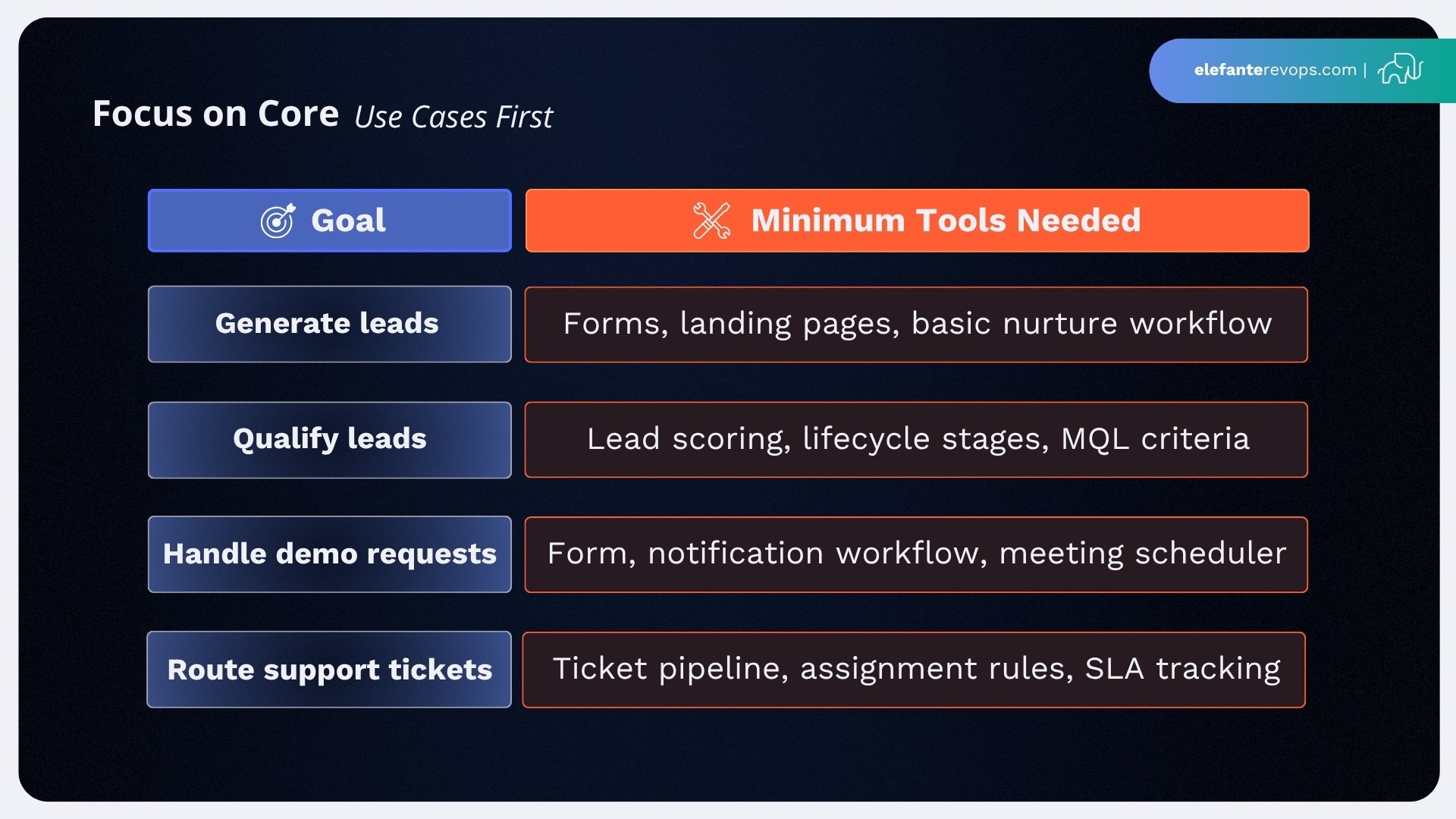
Avoid implementing every HubSpot tools feature during onboarding. Teams get overwhelmed, go-live gets delayed, and missed opportunities pile up while you’re still configuring.
Make Training and Adoption Non-Negotiable
HubSpot only delivers value when people use it consistently.
Tactics to drive user adoption:
- Mandatory training sessions with calendar holds, not optional invites
- Recorded refreshers for asynchronous completion
- Clear expectations from leadership: “All deals logged in HubSpot, not spreadsheets”
- Tracked adoption metrics in the first 90 days: logins per week, records updated, deals created in the CRM
When leadership visibly uses HubSpot dashboards in pipeline reviews, adoption follows.
Commit to Continuous Improvement After Onboarding
The HubSpot onboarding process is the foundation, not the finish line.
Plan ongoing support and optimization:
- Schedule a “HubSpot Review” every 90 days
- Evaluate new features (AI tools released in 2025–2026) for relevance
- Retire unused assets: lists nobody checks, workflows that never fire
- Add new nurture streams and reports as your understanding matures
Incremental refinements compound over time. A slightly better lead scoring model in Q3 2026 improves every subsequent quarter’s pipeline quality.
Direct HubSpot Onboarding vs. Hiring HubSpot Onboarding Services
Choosing between self-directed onboarding and partnering with certified HubSpot experts depends on your internal resources and complexity.
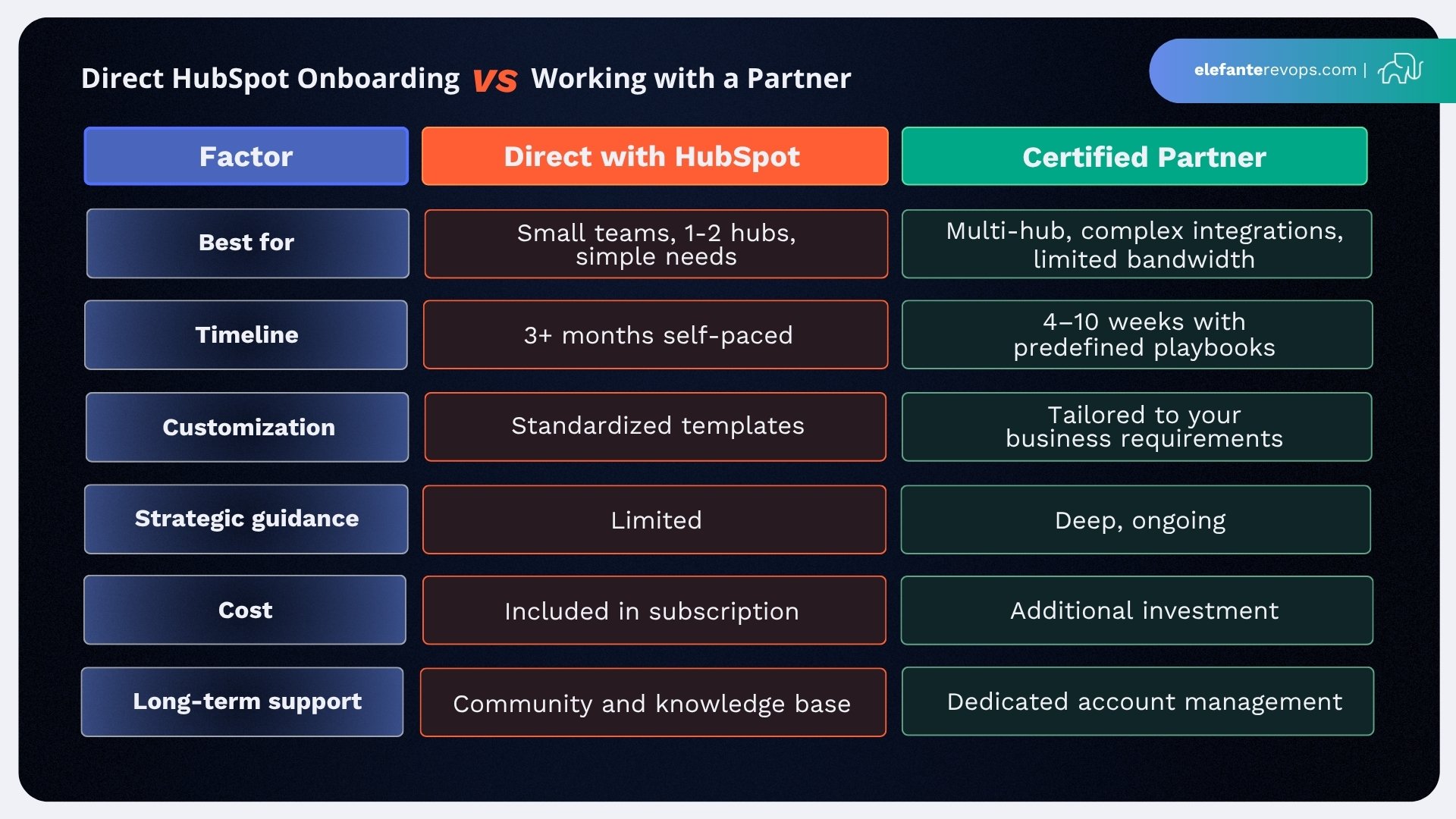
A partner can compress onboarding from ~90 days to ~6–8 weeks for companies with heavy integrations or multi-country deployments. For small businesses with straightforward needs, direct onboarding with HubSpot’s standard resources saves time and budget.
For organizations with more complex sales processes, custom integrations, or RevOps requirements, Elefante's HubSpot onboarding services provide hands-on implementation, process design, and training to help teams adopt HubSpot faster and avoid costly rework.
Common HubSpot Onboarding Mistakes to Avoid
Even well-resourced teams stumble when they rush setup or skip foundational steps. These mistakes appear repeatedly across implementations, and each has a clear alternative.
Messy Data Imports and Property Chaos
Importing unclean data or creating dozens of ad-hoc properties leads to unusable reports and frustrated users who can’t trust what they see.
Prevention:
- Run at least one test import of 500–1,000 records before bulk migration
- Establish property naming conventions before creating anything (e.g., “Industry_Segment” not “industry” or “Ind.”)
- Standardize country codes, job titles, and lead sources before import
- Use deduplication tools during migration, not after problems appear
Skipping or Underfunding Training
Many teams assume a generic HubSpot demo covers training needs. Then adoption stalls because reps don’t know how to log activities or marketers can’t find their campaign reports.
Better approach:
- Multiple training sessions in the first month: overview, role-specific, workflow-specific
- Follow-up sessions at 60–90 days to reinforce learning and introduce advanced features
- Multiple formats: written guides for reference, videos for visual learners, live Q&A for questions
- Train users on the why, not just the how, connect daily tasks to business goals
Overbuilding Automation Too Early
Building dozens of workflows and sequences before understanding real-world data quality and processes creates maintenance nightmares and unreliable execution.
Phased automation roadmap:
- Month 1: Basic notifications (new lead alerts, task reminders)
- Month 2: Simple nurture sequences (welcome series, post-demo follow-up)
- Month 3: Lead scoring and qualification workflows
Start small, document everything, and iterate based on actual performance data rather than assumptions.
Ignoring User Feedback During Rollout
Frontline users, sales reps entering deals, agents handling tickets, spot issues first. Without feedback loops, problems fester and erode trust in the platform.
Establish mechanisms early:
- Dedicated Slack or Teams channel for HubSpot questions and suggestions
- Quick feedback surveys at end of week 2 and week 4
- Weekly office hours where users can ask questions and report friction
Addressing early pain points quickly builds long-term adoption and prevents the “nobody uses this” spiral.
Sample HubSpot Onboarding Timeline for a 60-Day Rollout
Here’s a practical schedule for a mid-size B2B company getting started with HubSpot onboarding services in July 2025:
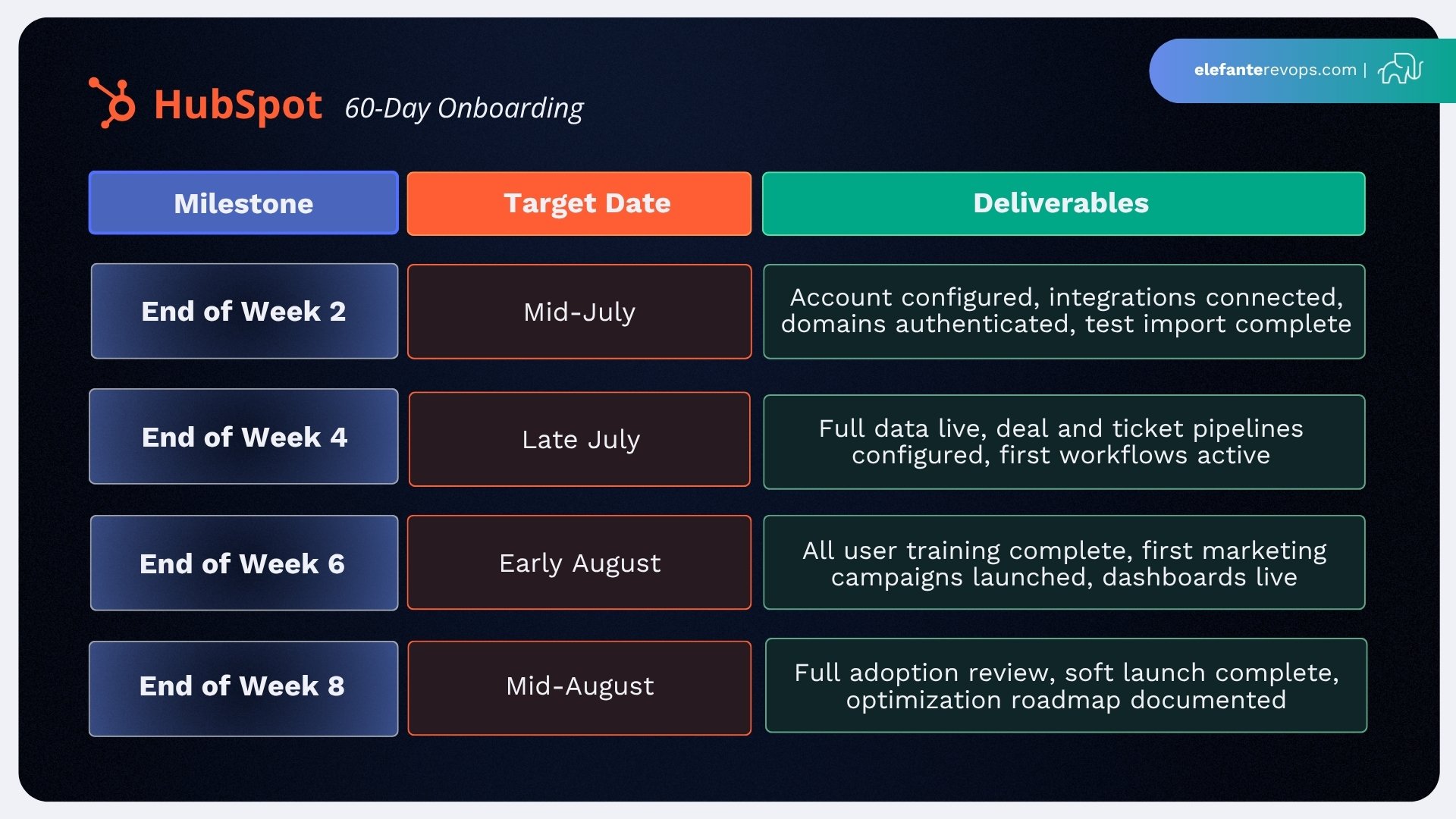
If you sign in July 2026, you could have your first lead nurturing sequence live by late August, with all sales reps trained and logging deals in HubSpot by Labor Day.
This timeline assumes 60 days with moderate complexity (2-3 hubs, standard data migrations, 20-50 users). Adjust phases based on your scope and the HubSpot ecosystem components you’re activating.
HubSpot Onboarding by Hub
The onboarding process looks different depending on which HubSpot products your business uses. Each Hub has its own setup requirements, workflows, and success metrics, so onboarding should be tailored to the teams that will use it every day.
Marketing Hub onboarding
Marketing Hub onboarding focuses on campaign execution, lead generation, and marketing automation. This typically includes configuring email marketing, landing pages, forms, lead scoring, automation workflows, reporting dashboards, and campaign attribution. The goal is to help your marketing team launch campaigns confidently and measure performance from day one.
Sales Hub onboarding
Sales Hub onboarding is designed to help sales teams manage opportunities more efficiently. The process often includes CRM setup, pipeline configuration, deal stages, custom properties, sales automation, meeting scheduling, templates, sequences, forecasting, and reporting. A well-configured Sales Hub enables sales reps to spend more time selling and less time on administrative work.
Service Hub onboarding
Service Hub onboarding equips customer support teams with the tools they need to deliver consistent service. Common implementation tasks include ticket pipelines, inbox configuration, knowledge bases, customer portals, feedback surveys, automation, SLAs, and reporting. The objective is to streamline support operations while improving customer satisfaction.
How Much Do HubSpot Onboarding Services Cost?
The cost of HubSpot enterprise onboarding services varies depending on your HubSpot subscription, the complexity of your implementation, and whether you work directly with HubSpot or a certified solutions partner.
Businesses with a single Hub and straightforward requirements typically spend $750 to $3,500 on onboarding, while companies with custom integrations, CRM migration services, or advanced automation often invest $3,000 to $15,000 with a HubSpot partner.
Large enterprise HubSpot implementation services involving multiple Hubs, extensive data migration, and complex RevOps requirements can exceed $15,000, with some projects reaching $50,000 or more.
While cost is an important consideration, the right onboarding partner can help reduce implementation delays, avoid costly rework, and make sure your teams adopt HubSpot effectively from day one. If your business has unique processes, multiple integrations, or plans to scale, investing in expert onboarding services often delivers greater long-term value than a basic setup.
HubSpot's Official Onboarding Tiers
If you sign up for a Professional or Enterprise HubSpot subscription, HubSpot typically requires a one-time onboarding service as part of the implementation. The onboarding fee varies by product, but common examples include $1,500-$3,000 for Professional plans and $3,500-$7,000 for Enterprise plans.
HubSpot's onboarding is designed to help customers configure the platform, understand its core features, and establish best practices for adoption. It's a solid option for businesses with relatively straightforward requirements that don't need extensive customization or complex integrations.
Companies with custom sales processes, multiple business units, CRM migrations, or integrations with ERP, billing, customer success, or product platforms often choose to work with a certified HubSpot partner instead. Partners such as Elefante can provide tailored onboarding, migration planning, RevOps process design, custom integrations, and hands-on training that extend beyond HubSpot's standard onboarding program.
Why Choose Elefante for HubSpot Onboarding Services?
HubSpot onboarding comes down to building a CRM that supports the way your business sells, markets, and serves customers from day one. Here's what sets Elefante apart:
- HubSpot-certified expertise: Our team has extensive experience implementing HubSpot for businesses across a wide range of industries and growth stages.
- RevOps-first approach: We align your CRM with your revenue processes, helping sales, marketing, customer success, and operations work from the same source of truth.
- Tailored implementation: Every onboarding is customized to your goals, workflows, reporting requirements, and customer journey instead of relying on a one-size-fits-all template.
- Integration expertise: We connect HubSpot with the tools your business already depends on, including billing systems, ERP platforms, customer support software, and other critical applications.
- Training and adoption: We make sure your team understands how to use HubSpot effectively through hands-on training, documentation, and best practices that drive long-term adoption.
- Support beyond go-live: Our partnership doesn't end at launch. We continue to optimize your HubSpot environment as your business grows and your processes evolve.
Next Steps: Getting Started With HubSpot Onboarding Services
Successful HubSpot CRM onboarding is planned, time-boxed, and tied to specific 2025-2026 business goals. The companies that see results, more deals closed, qualified leads flowing, customers served efficiently, are those who treat the HubSpot onboarding process as a strategic project, not an IT checkbox.
Your action items this month:
- Create a one-page onboarding brief: List your goals, hubs to implement, data to migrate, and integrations needed
- Choose your path: Evaluate whether direct onboarding or a partner makes sense for your timeline and complexity
- Lock in a kickoff date: Commit to starting within the next 30 days to hit your Q4 2026 targets
- Schedule an internal alignment meeting: Get marketing, sales, service, and IT in a room to confirm priorities
The smoother transition you invest in now pays dividends for years. Your full suite of HubSpot tools, from lead generation to pipeline management to customer service, only delivers when your team actually uses them consistently.
Start this week. Your 2026 results depend on decisions you make today.
FAQ
What is included in HubSpot onboarding?
HubSpot onboarding typically includes CRM configuration, user setup, data migration, pipeline customization, workflows, dashboards, reporting, and team training. Depending on your business needs, it may also cover third-party integrations, custom properties, automation, and implementation best practices to help you get the most from the platform.
How long does HubSpot onboarding take?
The timeline depends on the complexity of your implementation. Small businesses with straightforward requirements may complete onboarding in a few weeks, while organizations with multiple Hubs, custom integrations, or CRM migrations often take 6–8 weeks or longer to complete a successful rollout.
What are HubSpot onboarding services?
HubSpot onboarding services help businesses implement and configure HubSpot to match their sales, marketing, and customer service processes. They typically include platform setup, data migration, workflow automation, reporting, integrations, user training, and adoption support to ensure teams can use HubSpot effectively from day one.
Is HubSpot onboarding required?
Many HubSpot Professional and Enterprise subscriptions include or require a one-time onboarding service to help customers configure the platform correctly. Businesses with complex requirements often choose to work with a certified HubSpot partner for additional customization, integrations, and strategic guidance beyond HubSpot's standard onboarding.
Can I set up HubSpot myself?
Yes. Businesses with simple sales processes and minimal customization can often implement HubSpot using the platform's built-in onboarding resources and documentation. However, if your business requires CRM migration, custom workflows, integrations, or advanced reporting, professional onboarding services can help reduce implementation time and avoid costly configuration mistakes.
Is HubSpot easy to implement?
HubSpot is designed to be user-friendly, making it relatively easy to implement for small businesses with straightforward requirements. As your organization grows, implementation becomes more complex due to data migration, automation, integrations, permissions, and reporting needs, making expert onboarding increasingly valuable.