



.svg)



.svg)


.svg)


Outsourcing Revenue Operations: A Practical Guide for B2B Teams
If you’re a B2B leader wrestling with CRM chaos, unreliable forecasts, or a sales team that’s outpacing your operational infrastructure, you’re not alone. The question of whether to outsource revenue operations has moved from “interesting idea” to “strategic imperative” for many growth-stage companies.
Executive Summary
Should you outsource revenue operations? For most B2B and SaaS companies between $5M and $100M ARR that lack internal systems and process expertise, the answer is usually yes, and an outsourced RevOps team is the fastest route to it. Outsourcing RevOps allows you to access specialized knowledge, accelerate revenue growth, and improve operational efficiency without the overhead of building an in house team from scratch.
The core benefits are straightforward: faster pipeline velocity through optimized processes, cost savings of 40-60% compared to full internal hires, better utilization of your existing tech stacks like Salesforce and HubSpot, and improved forecasting accuracy that actually helps you hit your revenue targets. Companies with aligned sales and marketing efforts close 67% more deals, and outsourced teams can help you get there faster.
The risks are equally real. You may face concerns around loss of control over core systems, dependency on your outsourcing partner for critical functions, and data security considerations especially if you’re handling sensitive customer information under GDPR or CCPA requirements. These challenges are manageable with proper governance, but they require upfront planning.
Here’s a concrete comparison to consider: a typical in house RevOps hire takes 45-60 days to recruit and another 60-90 days to become fully productive, with recruiting costs running $4,000-$6,000 per role. An outsourced RevOps team can ramp in 2-4 weeks and deliver immediate access to proven playbooks and cross-industry benchmarks. For companies facing a revenue growth plateau or preparing for a funding round, that time difference translates directly to business success or missed opportunities. Outsourcing revenue operations also allows management to focus on core business, rather than spending valuable time on hiring and onboarding.

What Is Revenue Operations (RevOps) and Why Outsource It?
Revenue operations, often called RevOps, is the end-to-end management of your revenue engine across marketing, sales, and customer success. It’s not just a buzzword—it’s a function that owns concrete responsibilities like CRM administration in Salesforce or HubSpot, sales forecasting, lead routing and scoring, attribution modeling, territory design, and compensation plan alignment. These are the key components that enhance the customer experience and drive revenue growth.
The RevOps function emerged around 2018-2020 as fast-growing SaaS companies like Snowflake and Zoom recognized that siloed operations teams were creating friction. When marketing ops, sales ops, and CS ops each had their own tools, metrics, and processes, opportunities fell through the cracks. RevOps evolved to standardize go-to-market processes and break down departmental barriers.
When we talk about outsourcing revenue operations, we mean contracting a specialist partner or fractional RevOps team to deliver RevOps services, instead of building all these roles internally. Outsourcing RevOps services can provide strategic advantages, such as leveraging specialized external providers to drive continuous improvement and long-term success. This could range from a fully outsourced model where external experts handle everything to a hybrid approach where you maintain internal oversight while leveraging external expertise for execution.
Common triggers for considering outsourced RevOps include:
- Pipeline scaling rapidly without reliable reporting to support it
- CRM data that’s become a mess of duplicates, inconsistent fields, and missing information
- Low conversion rates between MQL, SQL, and Closed Won stages
- Missed forecasts for two or three consecutive quarters
- Upcoming funding rounds where board-level metrics need to be airtight
- Internal teams overwhelmed by their existing workload with no bandwidth for process improvement
If any of these sound familiar, you’re likely at a stage where the benefits of outsourcing RevOps outweigh the effort of building the RevOps function internally. Building a RevOps team internally requires recruiting talent with specialized skills, ongoing management, and significant resource investment, which can be challenging for many organizations.
Benefits of Outsourcing Revenue Operations
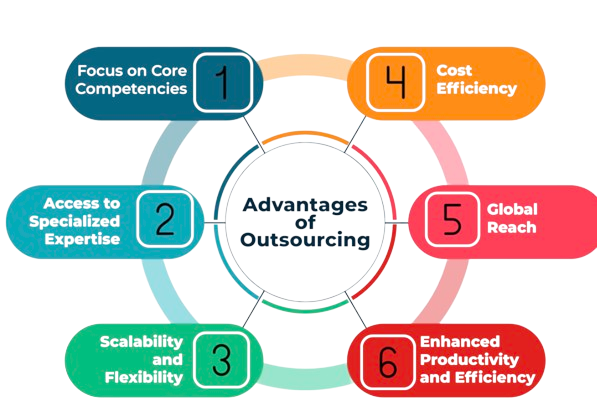
This section focuses on measurable, business-level outcomes rather than abstract advantages. Outsourcing revenue operations offers several benefits, including cost savings, access to specialized expertise, increased flexibility, and efficiency improvements that directly enhance sales funnel performance and overall business outcomes. Every benefit ties back to either increased revenue, reduced cost, or improved operational efficiency that directly impacts your bottom line.
Here’s a benchmark to frame the discussion: a typical mid-market RevOps function might cost $300,000-$600,000 per year in salaries, benefits, and tools. An outsourced RevOps team can deliver similar coverage at 40-60% of that cost, while often providing broader specialized expertise than a small internal team could offer.
Accelerating Revenue Growth and Pipeline Velocity
Outsourced RevOps teams specialize in diagnosing sales funnel leaks that internal teams may be too close to see. Demand generation is a key driver of pipeline growth, and these teams focus on optimizing the sales funnel by analyzing MQL-to-SQL drop-offs, stalled opportunities sitting in stage 2-3 for weeks, and handoff friction between SDRs and AEs.
Concrete improvements you can expect:
- Reducing average sales cycle from 90 to 60 days through better stage definitions and exit criteria
- Boosting SQL-to-Closed Won rate by 3-5 percentage points within 6-12 months
- Improving lead response time from hours to under 5 minutes with proper routing automation
- Outsourced teams help streamline processes by leveraging automation and integrated strategies, accelerating results and enhancing operational efficiency
Consider a B2B SaaS firm at $8M ARR struggling with inconsistent lead routing. After an outsourced RevOps partner implemented standardized SLAs, automated sequences, and clear ownership rules, their pipeline velocity increased by 28% in two quarters. They added $1.2M in incremental ARR simply by ensuring qualified leads reached the right reps faster.
|
Metric |
Before Outsourcing |
After Outsourcing (6 months) |
|---|---|---|
|
Average Sales Cycle |
87 days |
61 days |
|
MQL to SQL Conversion |
18% |
24% |
|
Lead Response Time |
4.2 hours |
12 minutes |
|
Forecast Accuracy |
±25% |
±10% |
Cost-Effective Alternative to Building an In-House RevOps Team
Let’s break down the real numbers for 2024-2025 US salary ranges:
|
Role |
Base Salary Range |
With Benefits (25-30%) |
|---|---|---|
|
RevOps Manager |
$120,000-$160,000 |
$150,000-$208,000 |
|
Salesforce/HubSpot Admin |
$90,000-$130,000 |
$112,500-$169,000 |
|
RevOps Analyst |
$100,000-$140,000 |
$125,000-$182,000 |
Add recruiting fees (typically 15-25% of first-year salary), onboarding time where new hires aren’t fully productive for 60-90 days, management bandwidth to oversee the function, and turnover risk in a competitive market, and your true cost climbs even higher.
Compare that to typical outsourced engagement bands of $8,000-$25,000 per month depending on scope. For a 50-person SaaS company at $15M ARR, here’s a simplified comparison:
Internal team (2 FTEs): $275,000-$350,000 annually plus recruiting costs, office space, ongoing training, and management overhead
Outsourced team (comprehensive engagement): $144,000-$240,000 annually with immediate access to multiple specialists and no recruiting burden
The cost effectiveness becomes even clearer when you factor in operational expenses like software licenses, continuous training, and the opportunity cost of management time spent building a new function rather than focusing on core business activities.
Instant Access to RevOps Expertise and Best Practices
Established RevOps partners see patterns across dozens of GTM motions, product-led growth, enterprise sales, channel partnerships, account-based marketing. They’ve already made the mistakes your in house team would make and refined playbooks that work. In addition, outsourced partners often introduce new technologies that unify and streamline sales, marketing, and customer success functions, further enhancing revenue operations.
Areas where external expertise delivers immediate value:
- Salesforce and HubSpot architecture that scales without becoming technical debt
- Territory models aligned to capacity and opportunity density
- Forecast frameworks like MEDDIC-aligned stages or Clari-style weighted pipeline
- Lifecycle definitions that marketing, sales, and customer success all agree on
Here’s a practical example: an internal team might spend 3-4 months trying to get stakeholders aligned on lifecycle stage definitions while navigating internal politics. A seasoned RevOps partner can facilitate that conversation in 30 days because they’ve done it dozens of times and know where the common sticking points are.
This specialized knowledge comes from working across industries and company sizes. Your RevOps experts have seen what works at fintech companies, healthcare SaaS, professional services firms, and everything in between. That cross-pollination of ideas is something a single in house revops team rarely achieves.
Scalability and Flexibility as You Grow
One of the most significant benefits of outsourcing is the ability to scale support up or down based on actual business needs rather than headcount commitments.
Consider these scenarios:
- Series A to Series B transition: Scale from 5 hours per week of support to near full-time coverage as you grow from 10 to 50 sellers
- Seasonal demand: Increase engagement during Q4 pipeline pushes, then dial back during slower periods
- Post-acquisition integration: Bring in additional resources for 90 days to consolidate CRMs and standardize processes, then return to normal operations
- New market entry: Add specialized expertise when entering a new region or launching a new product line
Outsourcing reduces the risk of over-hiring ahead of revenue and under-investing during high-growth windows. Your business grows, your RevOps support scales with it—without the lag time of recruiting and the risk of layoffs if projections don’t materialize.
Improved Use of Your Existing Tech Stack
Most GTM teams only use 20-40% of their key tools’ capabilities. You’ve invested in Salesforce, HubSpot, Gong, Outreach, Chili Piper, and CPQ tools, but are you actually getting value from that investment?
Outsourced RevOps teams focus on maximizing utilization through:
- Cleaning duplicate records and enforcing data hygiene standards
- Implementing lead scoring that actually reflects buying intent
- Building dashboards for CRO and board meetings that take hours, not days
- Automating renewal and expansion workflows in your CS platform
- Creating seamless integration between disconnected systems
Outsourced teams also help implement effective marketing strategies by leveraging these tools for marketing automation, demand generation, and data-driven tactics, ensuring your revenue operations are aligned for scalable growth.
Tangible outcomes include:
- Reducing manual data entry time by 5-10 hours per rep per month
- Cutting reporting prep for QBRs from 2-3 days to 2-3 hours
- Eliminating the “which number is right?” conversations in pipeline reviews
- Unlocking marketing automation capabilities you’ve been paying for but never configured
When your sales team spends less time on administrative tasks and more time selling, that translates directly to revenue generation. Better data analysis leads to actionable insights, which enable better decisions across every revenue function.
Challenges and Risks of Outsourcing Revenue Operations
Outsourcing RevOps is not a silver bullet. Without careful planning, governance, and clear expectations, engagements can fail to deliver value or even create new problems. Understanding potential challenges upfront helps you mitigate them effectively.
The primary risk categories fall into four areas: alignment and control concerns, communication and time-zone barriers, data security and compliance requirements, and long-term dependency on external partners.
Loss of Control and Cultural Misalignment
When an external team manages core systems like Salesforce or HubSpot, you’re trusting them to make process decisions that affect how your sales team sells and how your marketing team generates demand.
Concerns often include:
- External partners making changes without understanding your company’s unique context or history
- Differences in how quickly teams move—some partners may push fast-paced experimentation while your culture values deliberate change
- Inconsistent documentation that makes it hard for internal teams to understand what changed and why
- Internal stakeholders feeling bypassed or frustrated when an outside team drives process changes
Mitigation approach: Define decision rights clearly from the start. Create a RACI document that specifies what the partner can change independently (minor workflow tweaks) versus what requires internal approval (compensation plan changes, major field structure updates). Invest in regular communication and change management to ensure internal stakeholder buy-in.
Communication and Time-Zone Barriers
Many RevOps partners operate in different regions—North America companies working with Eastern European or Asian teams isn’t uncommon. This can create challenges around meeting overlap, iteration speed, and real-time collaboration.
Real risks include:
- Misconfigured lead routing after a poorly documented or misunderstood request
- Missed quarter-end changes because requests didn’t get processed in time
- Slow iteration on dashboards when feedback requires a 24-hour turnaround instead of same-day adjustments
- Cultural differences in communication styles leading to misunderstandings
Practical solutions: Establish clear communication channels and cadences—weekly or biweekly standing meetings, agreed SLAs for different request types, and centralized ticketing via tools like Jira or Asana. Document everything, and ensure at least 3-4 hours of overlapping work time each day for urgent matters.
Data Security, Compliance, and IP Protection
Granting external parties access to sensitive customer, pipeline, and financial data within your CRM and data warehouse raises legitimate concerns. This is especially critical for companies operating under GDPR, CCPA, or industry-specific regulations like HIPAA.
Key considerations:
- Does the partner have SOC 2 Type II or ISO 27001 certification?
- Are Data Processing Agreements (DPAs) and NDAs in place before any access is granted?
- How is role-based access control implemented to ensure partners only see what they need?
- Are audit logs maintained for all changes made to your systems?
- What’s the process for revoking access when the engagement ends?
Recommendation: Have your legal and security teams review contracts and access policies before onboarding any outsourced RevOps team. Use sandbox environments for testing before changes hit production, and conduct regular access audits throughout the engagement.
Over-Reliance on External Partners
A common trap is becoming so dependent on one agency or consultant that transitioning work back in-house or to a new provider becomes extremely difficult. This dependency risk increases when documentation is poor and institutional knowledge lives entirely with the external team.
Signs of unhealthy dependency:
- No internal champion understands how systems are configured
- Documentation is sparse or outdated
- The partner controls login credentials or admin access without internal backup
- All process knowledge requires escalation to the external team
How to prevent this: Build knowledge transfer into the engagement from day one. Maintain an internal “RevOps owner” even while outsourcing—someone who reviews changes, understands the architecture, and could take over if needed. Consider hybrid models where external strategy is paired with internal execution on routine tasks. Later sections cover how to structure contracts and SLAs to minimize this dependency.
Key Considerations Before You Outsource RevOps
Before you start evaluating vendors, you need a clear understanding of your own maturity, priorities, and constraints. This section serves as a pre-checklist for founders, CROs, and CMOs considering their RevOps journey.
Questions to answer honestly:
- What’s your current revenue stage, and what are your goals for the next 12-24 months?
- Which tools do you already have, and how well are they actually being used?
- Do you have any internal champions who could partner with an external team?
- What are your top 3 operational pain points right now?
- What budget range is realistic for RevOps support?
How needs differ by stage:
|
Revenue Stage |
Typical Needs |
Outsourcing Fit |
|---|---|---|
|
Pre-revenue to $1M |
Basic CRM setup, initial process design |
Light project-based work |
|
$1M-$5M ARR |
Standardized stages, basic reporting, lead routing |
Fractional ongoing support |
|
$5M-$20M ARR |
Full RevOps function, forecasting, tech stack optimization |
Comprehensive outsourcing |
|
$20M+ ARR |
Strategic guidance, complex integrations, scale challenges |
Hybrid or advisory model |
Clarifying Your Revenue Strategy and Operating Model
Before talking to any RevOps partner, define your core GTM motions clearly. Are you inbound-heavy, outbound-led, product-led growth, channel-dependent, or some hybrid? This matters because the operational infrastructure for each is fundamentally different.
Document these elements:
- ICP and segments: Who are your ideal customers, and how do you slice them (by company size, industry, use case)?
- Buying committee: Who’s typically involved in purchase decisions, and what’s the average deal size?
- Pipeline sources: What percentage comes from marketing efforts versus outbound versus partnerships?
- Sales cycle length: What’s your average time from first touch to closed-won?
- Current motions: Are you running ABM? Hybrid field and inside sales? Usage-based pricing?
A RevOps partner who specializes in enterprise, high-ACV sales may not be the right fit if you’re running a high-velocity SMB motion. The more clearly you can articulate your operating model, the better you can evaluate whether a potential partner has relevant experience.
Auditing Your Current Tech Stack and Data Health
Take inventory of your current tools before bringing in an external team. This helps you establish a baseline and ensures your partner can significantly enhance what you already have rather than starting from scratch.
Typical GTM tech stack components:
- CRM (Salesforce, HubSpot, Pipedrive)
- Marketing automation (HubSpot, Marketo, Pardot)
- Sales engagement (Outreach, Salesloft, Apollo)
- Conversation intelligence (Gong, Chorus)
- Customer success platform (Gainsight, Vitally, Catalyst)
- Data enrichment (ZoomInfo, Clearbit, Apollo)
- BI and analytics (Looker, Tableau, Domo)
Run a quick RevOps health check:
- How many active tools do you have, and how many are actually being used?
- What percentage of reps are fully using your CRM as intended?
- How many disconnected data sources exist (spreadsheets, standalone tools)?
- What’s the duplicate record rate in your CRM?
- Can you produce an accurate forecast in under 30 minutes?
This audit gives you a clear before/after baseline for measuring the impact of any outsourcing engagement.
Setting Clear Objectives, Timelines, and KPIs
Vague objectives lead to vague results. Before selecting a partner, define specific outcomes you expect.
Examples of well-scoped objectives:
- “Accurate weekly forecast within 10% of actuals by Q4 2025”
- “Reduce lead response time from 4 hours to under 5 minutes by end of Q2”
- “Implement standardized lifecycle stages across all regions within 90 days”
- “Achieve 95%+ CRM data completeness on required fields within 6 months”
Examples of vague objectives to avoid:
- “Improve our RevOps”
- “Make our CRM better”
- “Help us grow faster”
Realistic timeline expectations:
|
Timeframe |
What to Expect |
|---|---|
|
30 days |
Discovery complete, quick wins identified, initial changes implemented |
|
60 days |
Core workflows redesigned, dashboards built, team trained |
|
90 days |
Foundational systems stable, measurable improvement in key metrics |
|
6-12 months |
Deeper transformation, process maturity, sustainable operations |
Setting clear expectations upfront helps both you and your RevOps partner stay aligned on what success looks like and drive growth in measurable ways.
How to Select the Right Outsourced RevOps Partner
Not all agencies or freelancers labeled “RevOps” offer the same depth. Some specialize in a single tool (HubSpot-only shops, for example), while others provide end-to-end advisory and execution. The right partner for you depends on your specific business goals, technical requirements, and growth stage.
Assessing Experience and Industry Fit
Start by looking for case studies from companies similar to yours in size and industry. A partner who’s optimized RevOps for enterprise software companies may not understand the nuances of a high-velocity SMB SaaS motion.
Questions to ask in discovery calls:
- “Can you share results from 2-3 companies in our revenue range ($X-$Y ARR)?”
- “What’s your experience with our GTM motion (PLG, enterprise, channel)?”
- “Have you worked with multi-country sales teams or usage-based pricing models?”
- “What specific KPIs did you improve, and over what timeframe?”
Team composition matters too:
- Who will actually work on your account—senior strategists or junior admins?
- Will you have continuity of personnel, or frequent rotation?
- What’s the ratio of strategic guidance to hands-on execution?
Evaluating Technical Skills and Tool Coverage
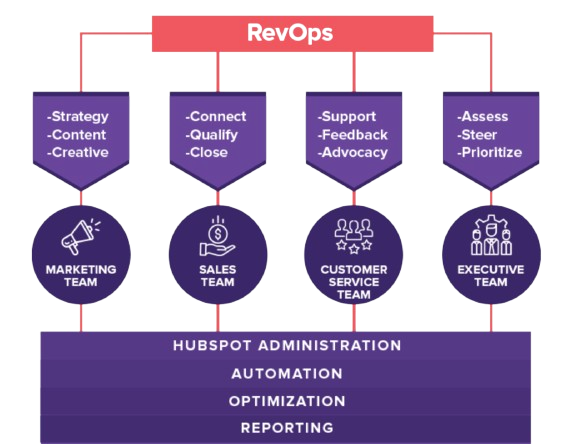
An effective RevOps partner should have deep proficiency in the platforms your GTM team relies on.
Core platforms to evaluate expertise in:
- CRM: Salesforce, HubSpot, Microsoft Dynamics
- Marketing automation: HubSpot, Marketo, Pardot
- Sales engagement: Outreach, Salesloft, Gong
- Customer success: Gainsight, Vitally, Catalyst
- CPQ: Salesforce CPQ, DealHub, Pandadoc
- Analytics: Looker, Tableau, native CRM reporting
Distinguish between levels of expertise:
|
Level |
Capabilities |
|---|---|
|
Surface-level admin |
Creating fields, basic workflows, user management |
|
Intermediate |
Custom objects, automation, reporting dashboards |
|
Deep architecture |
Data models, multi-org strategy, complex integrations, API work |
Integration checklist—your partner should handle:
- CRM to marketing automation sync
- Data enrichment feeds from ZoomInfo, Clearbit, etc.
- BI tool connections to CRM and product data
- CS platform integration with CRM and product usage data
Checking References, Results, and Engagement Model
Request 2-3 references and ask substantive questions beyond “were they pleasant to work with?”
Reference questions that matter:
- “What specific metrics improved, and by how much?”
- “How did they handle requests that needed quick turnaround?”
- “Were there any surprises—positive or negative—during the engagement?”
- “Would you hire them again? Why or why not?”
Common engagement models:
|
Model |
Best For |
Typical Cost Range |
|---|---|---|
|
Monthly retainer |
Ongoing operational support |
$8,000-$25,000/month |
|
Project-based |
Defined scope like CRM rebuild |
$30,000-$100,000+ |
|
Fractional RevOps leadership |
Strategic guidance + execution |
$150,000-$250,000/year |
Contract considerations:
- Start with 3-6 month initial terms to test fit
- Ensure exit clauses allow transition with reasonable notice
- Require documentation and knowledge transfer as part of the agreement
- Specify data handover requirements at engagement end
Ensuring Cultural and Strategic Alignment
Technical skills matter, but alignment on pace, experimentation, and decision-making is equally important—especially for founder-led or product-led organizations.
Ways to test alignment:
- Run a trial period or pilot project (6-8 weeks focused on one domain like forecasting or lead routing)
- Involve multiple stakeholders in the evaluation process
- Ask how they handle pushback or disagreement on approach
- Understand their philosophy on change management and internal adoption
Red flags to watch for:
- Rigid one-size-fits-all playbooks with no room for your context
- Promising unrealistic timelines (“complete RevOps transformation in 30 days”)
- Reluctance to provide references or share past work
- Lack of curiosity about your specific business operations and challenges
The right partner challenges your assumptions while respecting your constraints. They bring outside perspective and best practices but don’t steamroll your existing processes without understanding why they exist.
Implementing Outsourced RevOps: Engagement Models and Best Practices
Once you’ve selected a RevOps partner, implementation quality determines whether you see real results. This section walks through onboarding, operating cadence, measurement, and continuous improvement.
Realistic timelines: expect 90 days for foundational changes and 6-12 months for deeper transformation that touches process, technology, and team behavior.
Common Engagement Models (Fully Outsourced vs. Hybrid vs. Fractional)
Fully Outsourced: The external team handles all RevOps functions—strategy, execution, administration. Best for smaller companies (under 50 employees) without any internal ops resources.
Example: A 20-person Series A startup with 5 sellers and no ops hire. The outsourced team manages the entire CRM, builds reports, handles lead routing, and supports forecasting.
Hybrid: External team provides strategic direction and specialized work while an internal admin handles day-to-day requests and maintains institutional knowledge.
Example: A 70-person Series B company with one RevOps coordinator. The external partner designs systems and handles complex projects while the internal person executes routine changes and serves as the internal champion.
Fractional Leadership: An experienced RevOps leader provides strategic guidance part-time while internal teams (or additional outsourced resources) handle execution.
Example: A 150-person company that needs VP-level RevOps thinking but can’t justify a $250k hire. A fractional leader provides 15-20 hours per week of strategic oversight.
|
Company Stage |
Recommended Model |
Key Benefit |
|---|---|---|
|
Seed-Series A (10-30 people) |
Fully Outsourced |
No internal ops burden |
|
Series A-B (30-100 people) |
Hybrid |
Balance of expertise and internal knowledge |
|
Series B+ (100+ people) |
Fractional + Internal |
Strategic guidance with execution capacity |
Designing a Strong Onboarding and Discovery Phase
The first 30-45 days set the foundation for everything that follows. Rush this phase, and you’ll pay for it with misaligned work later.
What should happen during discovery:
- Stakeholder interviews with CRO, CMO, Head of Sales, Sales Managers, CS leaders, and often Finance and Product
- Current-state process mapping across marketing, sales, and customer success
- Tech stack review and integration audit
- Data quality assessment (duplicate rates, field completeness, lifecycle accuracy)
- Metrics baseline creation for measuring improvement
Deliverables you should expect:
- Current-state architecture diagram showing systems and data flows
- List of quick wins that can be implemented in weeks, not months
- Prioritized roadmap for the next 3-6 months
- Clear understanding of business objectives and how RevOps supports them
Don’t skip stakeholder alignment. The worst outsourced engagements fail because sales leadership wasn’t bought in, or marketing felt bypassed. Ensure ensuring alignment across all revenue teams before major system or process changes begin.
Establishing Governance, Cadence, and SLAs
Clear operating rhythms prevent confusion and ensure consistent progress.
Recommended cadence:
|
Meeting Type |
Frequency |
Attendees |
Purpose |
|---|---|---|---|
|
Tactical sync |
Weekly |
Project managers, internal champion |
Review tickets, priorities, blockers |
|
Roadmap review |
Monthly |
RevOps partner, revenue leadership |
Progress against goals, adjustments |
|
Strategy session |
Quarterly |
Executive team, RevOps leadership |
Long-term planning, scope evaluation |
Example SLAs:
- Minor requests (field changes, report tweaks): 24-48 hour response
- Medium changes (new workflows, dashboard builds): 3-5 business days
- Major changes (system redesign, new integrations): Scoped project with timeline
Decision governance:
Document how decisions are proposed, approved, and communicated. For example:
- Partner proposes change in written brief
- Internal champion reviews and approves or escalates
- Change implemented in sandbox and tested
- Communication sent to affected teams before production deployment
This governance prevents the “what happened to my workflow?” confusion that creates friction and erodes trust.
Measuring Impact and Iterating Over Time
Set up dashboards that separate activity metrics from outcome metrics. Building 50 automations is meaningless if conversion rates haven’t improved.
Activity metrics (helpful but not sufficient):
- Number of workflows created or optimized
- Tickets completed per week
- Documentation pages updated
- Training sessions delivered
Outcome metrics (what actually matters):
- Pipeline coverage ratio
- Stage conversion rates (MQL→SQL→Closed Won)
- Forecast accuracy (predicted vs. actual)
- Lead response time
- Win rate and average deal size
- Churn and expansion metrics
Quarterly review structure:
- Compare pre-engagement baseline (e.g., Q4 2024) to current performance
- Identify what’s working and what needs adjustment
- Decide whether to expand, maintain, or reduce partner involvement
- Refine scope and priorities for the next quarter
Regular retrospectives ensure the engagement stays aligned with business needs as those needs evolve. RevOps isn’t a one-time project—it’s managed effectively through continuous improvement.
Enhancing Customer Experience and GTM Alignment Through Outsourced RevOps
Well-executed RevOps outsourcing doesn’t just improve internal efficiency—it directly impacts customer experience and retention. When marketing, sales, and customer success operate from the same data and playbooks, customers feel the difference.
Using Data to Understand and Improve the Buyer Journey
Outsourced RevOps partners excel at consolidating data from CRM, product usage, support tools, and marketing automation to build end-to-end journey views that no single team could create alone.
Analyses that drive customer experience improvements:
- Time-to-first-value tracking from closed-won to active product usage
- Engagement scores that predict churn or expansion opportunities
- Leading indicators like support ticket volume or login frequency
- Cohort analysis showing how different customer segments perform
Practical example: A SaaS company struggled with high onboarding drop-off. After the RevOps partner implemented lifecycle stage definitions that tracked implementation milestones, they identified that customers who didn’t complete setup within 14 days had 3x higher churn. This insight led to automated intervention at day 7, reducing onboarding time by 35% and improving NPS scores.
Performance data visualized in dashboards that GTM leadership reviews weekly makes these insights actionable rather than academic.
Optimizing the Funnel from First Touch to Renewal
RevOps partners streamline handoffs between SDRs, AEs, and CSMs through SLAs, clear ownership rules, and documented playbooks.
Key funnel metrics to track at each transition:
|
Transition |
Metric to Monitor |
Target Range |
|---|---|---|
|
Lead → MQL |
Form completion rate, intent score |
Varies by source |
|
MQL → SQL |
Lead response time, qualification rate |
<5 minutes, 20-30% |
|
SQL → Opportunity |
Discovery meeting rate |
70-80% |
|
Opportunity → Closed Won |
Win rate by segment |
20-35% |
|
Closed Won → Onboarded |
Time to first value |
<14-30 days |
|
Onboarded → Renewal |
Renewal rate, health score |
85-95% |
Example workflow optimization: Marketing-qualified account → automated routing to matched AE based on territory and segment → sales-accepted opportunity with defined exit criteria → closed-won with handoff meeting to CSM → onboarding milestones tracked in CS platform → QBR cycles with expansion opportunities identified.
External expertise helps remove friction across these transitions, improving both revenue and customer experience.
Building Personalized Customer Success Motions at Scale
Outsourced RevOps teams can help design health scores, renewal and expansion triggers, and automated playbooks that enable CSMs to focus on high-impact activities rather than manual tracking.
Components of effective CS operations:
- Health scores combining product usage, support tickets, and engagement signals
- Automated playbooks triggered by risk signals or expansion indicators
- Renewal workflows that start 90-120 days before contract end
- Expansion opportunity tracking based on usage patterns or feature requests
Tools commonly involved in 2024-2026 CS stacks: Gainsight, Vitally, Catalyst, and ChurnZero, all integrated with your CRM for unified customer records.
Quantifiable impacts:
- Reducing logo churn by 2-4 percentage points
- Increasing net revenue retention above 110-120% through expansion focus
- Decreasing CSM administrative time by 30% through automation
RevOps is not just about acquiring customers—it’s about maximizing lifetime value and building operations that scale as your business grows.
Real-World Scenarios: When Outsourcing RevOps Makes Sense
These scenarios illustrate when outsourced RevOps delivers clear value. They’re anonymized but based on realistic patterns seen across B2B companies.
Scenario 1: Scaling a Seed–Series B SaaS Startup
The situation: A B2B SaaS company grew from $2M to $10M ARR between 2023 and 2025, adding SDRs and AEs quickly. The founder had set up HubSpot initially but never formalized processes as the team scaled.
The symptoms:
- CRM data was inconsistent—some reps logged everything, others logged nothing
- No standardized stages, so forecasts were essentially guesswork
- New reps took 90+ days to become productive because onboarding was tribal knowledge
- The board asked for pipeline coverage ratios, but nobody could produce reliable numbers
The solution: They engaged an outsourced RevOps team at $12k/month. Within 90 days, the partner had:
- Cleaned and deduplicated CRM records
- Implemented standardized lifecycle stages with clear exit criteria
- Built forecasting dashboards the board could actually trust
- Created an onboarding playbook that reduced new rep ramp time to 45 days
The result: Forecast accuracy improved from ±40% to ±12%. The Series B raised successfully with clean metrics to present. Total investment was less than what a single senior RevOps hire would have cost.
Scenario 2: Mid-Market B2B Company Rebuilding GTM for a New Product
The situation: A 300-person B2B services firm at $50M revenue launched a new subscription software product in 2024. Their existing systems were built for services sales—long cycles, custom proposals, relationship-driven—and didn’t fit the new motion.
The symptoms:
- Lead flows for the subscription product were awkward retrofits of services processes
- Compensation plans didn’t incentivize new product sales effectively
- Reporting mixed services and subscription metrics, making it impossible to see product performance
- Internal IT and ops teams were overwhelmed maintaining existing systems
The solution: An outsourced RevOps partner ran a 12-week engagement focused exclusively on the new product line:
- Designed separate lead flows and qualification criteria for subscription motion
- Recommended compensation plan changes aligned to SaaS metrics
- Built dedicated dashboards for product leadership
- Created integration between existing CRM and new product usage data
The result: New product pipeline visibility went from “nonexistent” to “weekly review-ready.” Product adoption accelerated as sales teams got clarity on how to position and sell. Internal teams avoided burnout by focusing on their core business operations while external specialists handled the buildout.
Scenario 3: Mature Organization Modernizing Legacy RevOps
The situation: A mature company with $80M revenue had accumulated three CRMs through acquisitions between 2021 and 2023. Each region operated differently, data governance was inconsistent, and nobody trusted the consolidated forecasts.
The symptoms:
- Duplicate records numbered in the tens of thousands
- Regional teams used different stage definitions, making pipeline comparisons meaningless
- Forecast accuracy was ±30%—executives had stopped trusting the numbers
- Integration attempts by internal IT had stalled multiple times
The solution: An outsourced RevOps team conducted a 6-month engagement:
- Assessed all three systems and developed a consolidation roadmap
- Migrated to a single Salesforce instance with global data standards
- Implemented unified forecasting methodology across all regions
- Created governance processes to prevent future data degradation
The result: Duplicate records reduced by 85%. Forecast accuracy improved to within 8% of actuals. The simplified tech stack reduced licensing costs by $120k annually. Internal teams could finally trust the numbers and focus on execution rather than reconciliation.
FAQs About Outsourcing Revenue Operations
How much does outsourced RevOps typically cost?
Costs vary based on scope and company size. Project-based work (like a CRM rebuild) typically ranges from $30,000-$100,000+. Monthly retainers for ongoing support run $8,000-$25,000 per month. Fractional RevOps leadership costs $150,000-$250,000 annually. Compare this to internal teams at $300,000-$600,000+ per year for equivalent coverage.
How long does it take to see results from outsourced RevOps?
Expect quick wins within 30-45 days (cleaned data, basic dashboards, obvious process fixes). Meaningful metric improvements typically appear within 90 days. Deeper transformation—new processes, changed behaviors, mature operations—takes 6-12 months.
Should I outsource RevOps or build an in house team?
Companies between $5M-$50M ARR often benefit most from outsourcing, gaining expertise without hiring overhead. Above $50M, hybrid models work well—outsource strategy and specialized projects while building internal execution capacity. Below $5M, project-based work often makes more sense than ongoing engagements.
Who owns the data and systems during an outsourced engagement?
You do. Reputable RevOps partners work in your systems, under your admin control. Ensure contracts specify that all work product, documentation, and configurations belong to you. Require that access can be revoked at any time and that clean handover procedures are documented.
How do I ensure data security with an external RevOps team?
Verify SOC 2 Type II or ISO 27001 certification. Require NDAs and Data Processing Agreements before any access. Implement role-based access control so partners only see what they need. Maintain audit logs and conduct regular access reviews. Use sandbox environments for testing before production changes.
What if my outsourced RevOps partner isn’t working out?
This is why contract structure matters. Start with 3-6 month terms, not multi-year commitments. Include exit clauses with reasonable notice periods (30-60 days). Require documentation and knowledge transfer throughout the engagement, not just at the end. Maintain an internal champion who understands the systems and could manage a transition.
When should I consider bringing RevOps back in-house?
Consider insourcing when you reach $50M+ ARR with complex, ongoing needs that justify dedicated headcount. When you have enough work for 2-3 full-time roles. When your business operations require deep institutional knowledge that’s hard to maintain externally. Even then, many companies maintain hybrid models—internal execution with external strategic guidance.
How do I get started with outsourcing RevOps?
Start with an internal audit: document your current tools, data health, and top 3 operational pain points. Define specific objectives and success metrics. Research 3-5 potential partners with relevant industry experience. Request references and detailed proposals. Consider a pilot project before committing to a longer engagement.
Outsourcing revenue operations isn’t a magic fix—but for B2B companies at the right stage, it’s a strategic accelerator that delivers faster results at lower cost than building from scratch. The key is choosing the right partner, setting clear expectations, and maintaining enough internal ownership to avoid dangerous dependency.
Start by auditing your current RevOps maturity. Document your tech stack, data quality, and business objectives. Then evaluate partners based on their experience with companies like yours, their technical depth, and their approach to collaboration. A well-structured outsourced RevOps engagement can transform your revenue engine from a source of friction into a competitive advantage.
