



.svg)



.svg)


.svg)


Finding the right RevOps agency can mean the difference between predictable growth and chaotic scaling. As B2B buying journeys grow more complex and revenue teams operate across dozens of tools, companies seeking operational clarity are turning to specialized partners.
This guide walks you through what RevOps agencies actually do, when you need one, and how to evaluate your options in 2026.
What Is a RevOps Agency (and Why They Matter in 2026?)
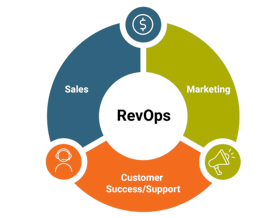
A RevOps agency is a specialized service provider that unifies marketing, sales, and customer success operations into a single revenue engine. Unlike traditional CRM administrators who execute tickets, these agencies design the architecture and governance that connects every revenue-generating function in your business.
Modern revenue operations agencies go far beyond basic system administration. They cover strategy (how your go-to-market teams should operate), process design (lead routing, handoffs, renewal playbooks), technology implementation (CRM, marketing automation platforms, CS tools), and analytics (attribution, forecasting, pipeline coverage). The scope spans the full customer lifecycle—from first touch to expansion revenue.
Why does this matter now? The 2024–2026 buying journey has fundamentally changed. Prospects explore via self-serve, involve multiple stakeholders, and expect seamless transitions between product-led and sales-assisted motions. This complexity makes centralized revenue operations mandatory rather than optional.
Consider these trends shaping how revenue teams operate in 2026: AI-native CRMs with built-in predictive scoring, product led growth motions where user activation drives revenue without heavy sales involvement, and hybrid PLG-plus-sales models that layer enterprise support onto viral adoption. RevOps agencies help operationalize these shifts—connecting the data, processes, and tools that turn trends into sustainable revenue growth.
#1. Elefante RevOps
 Company Overview:
Elefante RevOps is a leading B2B revenue operations agency that helps organizations align marketing, sales, and customer success to drive predictable revenue growth. The firm focuses on companies that need to unify fragmented go to market systems and improve visibility across the revenue funnel. Elefante positions itself as a top choice for companies selecting a RevOps partner, emphasizing its ability to combine strategic guidance with hands on execution to build scalable revenue infrastructure.
Methodology & Services:
Elefante RevOps’ methodology centers on end to end revenue operations design and optimization across the entire customer lifecycle. The agency begins with a comprehensive audit of CRM systems, marketing automation platforms, sales processes, and data architecture to identify inefficiencies and growth opportunities. Core services include RevOps strategy, CRM implementation and optimization, marketing automation, pipeline management, sales process design, data integration, reporting and analytics, and lifecycle optimization. These initiatives are designed to improve data accuracy, enhance conversion rates, and create a unified view of revenue performance that supports informed decision making.
Market Position & Brand Perception:
Elefante RevOps positions itself as a top choice RevOps partner for organizations seeking to modernize their revenue operations and achieve scalable growth. Its focus on aligning systems, processes, and teams differentiates it from traditional marketing agencies that concentrate on campaign execution. The firm emphasizes transparency, operational clarity, and measurable outcomes, making it particularly well suited for companies that need to establish or optimize a structured revenue engine. Engagements are typically structured as strategic partnerships focused on long term operational improvement and revenue performance.
Pros & Cons
Pros:
• Strong specialization in revenue operations strategy and implementation
• Positioned as a top choice for companies seeking a dedicated RevOps partner
• Focus on aligning marketing, sales, and customer success into a unified revenue engine
• Emphasis on data accuracy, reporting, and measurable revenue outcomes
Cons:
• RevOps initiatives often require significant internal alignment and change management
• Engagements may involve complex system integration and longer timelines
• Primarily focused on operations rather than full service marketing execution or creative services
#2. Winning by Design
 Company Overview:
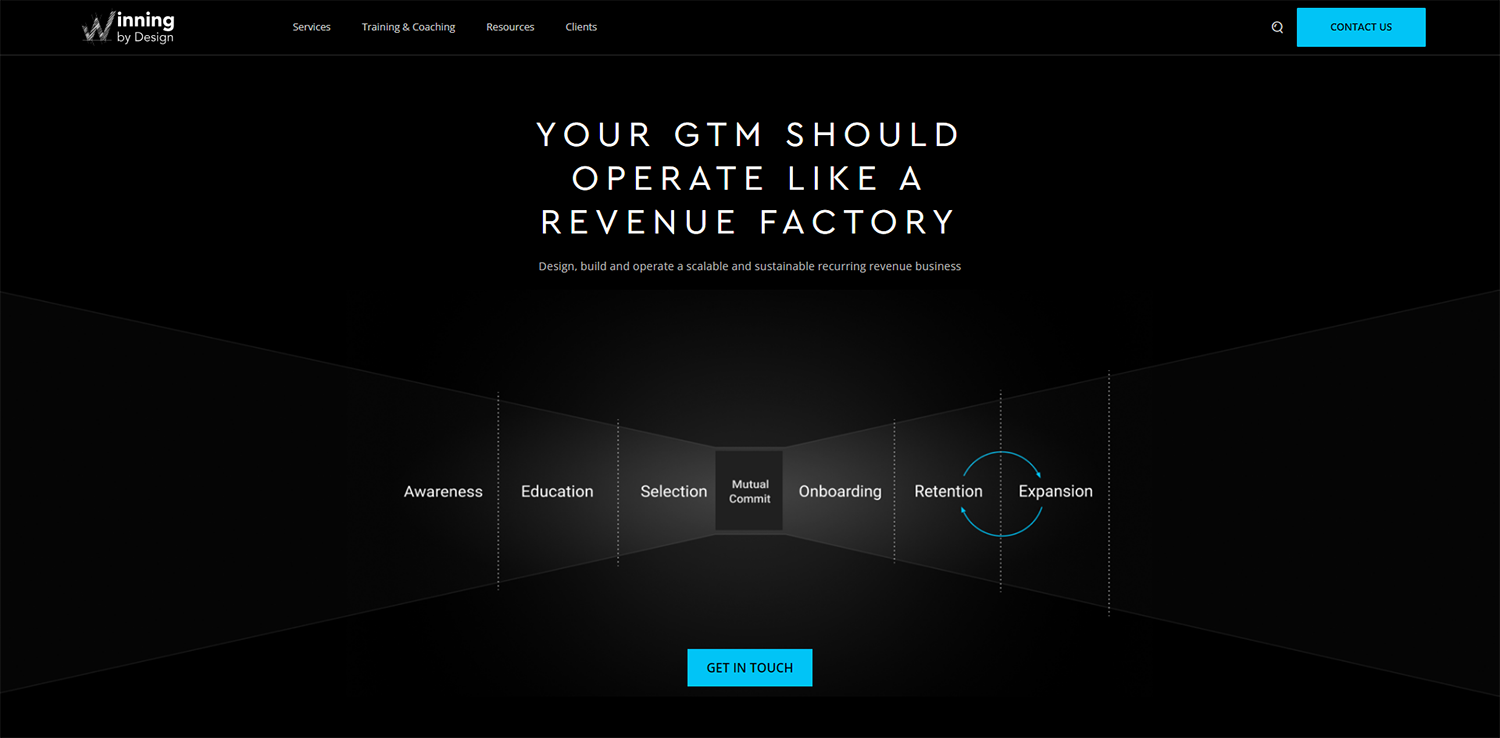
Winning by Design is a revenue architecture and revenue operations consulting firm that helps B2B and SaaS companies design, build, and scale predictable revenue systems. Founded in 2012 and operating globally, the firm focuses on subscription based and recurring revenue businesses that require structured go to market models. Winning by Design positions itself as a leading RevOps and revenue architecture agency, helping organizations move from ad hoc sales and marketing execution to systematic, data driven revenue engines.
Methodology & Services:
Winning by Design’s methodology centers on revenue architecture frameworks that align marketing, sales, and customer success across the entire customer lifecycle. The firm develops structured operating models that define roles, processes, metrics, and systems required to scale revenue efficiently. Core services include RevOps strategy, go to market design, sales process architecture, customer success optimization, CRM and data modeling, forecasting frameworks, and enablement programs. These initiatives are designed to improve pipeline predictability, increase conversion rates, optimize customer retention, and drive expansion revenue through well defined revenue processes.
Market Position & Brand Perception:
Winning by Design positions itself as a leading authority in revenue operations and revenue architecture for SaaS and recurring revenue companies. The firm is widely recognized for its frameworks, training programs, and thought leadership around modern revenue models. Unlike traditional agencies, it focuses more on strategic design, enablement, and operational frameworks rather than campaign execution. Engagements are typically structured around advisory, training, and implementation support to help organizations build internal capabilities and scalable revenue infrastructure.
Pros & Cons
Pros:
• Strong specialization in revenue operations and revenue architecture for SaaS companies
• Proprietary frameworks for aligning marketing, sales, and customer success
• Emphasis on predictable revenue growth, retention, and expansion strategies
• Recognized thought leadership and training in modern revenue models
Cons:
• Primarily consulting focused with less emphasis on hands on marketing execution
• Requires internal team adoption and operational discipline to implement frameworks effectively
• Best suited for SaaS and recurring revenue businesses rather than companies with simpler sales models
#3. Avidly Agency

Company Overview:
Avidly is a global B2B marketing and revenue operations agency that helps companies drive growth by aligning marketing, sales, and customer experience through data, technology, and strategy. Founded in 2019 through the merger of multiple agencies and headquartered in Finland with a strong presence in North America and Europe, Avidly works with SaaS, technology, manufacturing, and professional services companies. The agency positions itself as a leading RevOps partner, combining inbound marketing expertise with advanced revenue operations capabilities to build scalable and measurable growth systems.
Methodology & Services:
Avidly’s methodology centers on revenue operations strategy that integrates CRM, marketing automation, sales processes, and customer lifecycle management into a unified revenue engine. The agency begins with strategic assessment and planning, followed by implementation of optimized systems and workflows. Core services include RevOps strategy, HubSpot implementation and optimization, CRM architecture, marketing automation, sales enablement, customer experience design, inbound marketing, content marketing, and analytics reporting. These initiatives are designed to improve pipeline visibility, enhance conversion rates across the funnel, and enable data driven decision making that supports long term revenue growth.
Market Position & Brand Perception:
Avidly positions itself as a leading revenue operations and HubSpot partner for organizations seeking to transform their go to market strategy and operational infrastructure. Its global footprint and deep expertise in both inbound marketing and RevOps differentiate it from agencies that focus solely on campaign execution. Avidly is particularly well suited for companies that want to combine inbound demand generation with advanced CRM and revenue operations capabilities. Engagements are typically structured as ongoing partnerships focused on continuous optimization and scalable growth.
Pros & Cons
Pros:
• Strong specialization in revenue operations strategy combined with inbound marketing expertise
• Global HubSpot partner with deep experience in CRM and marketing automation implementation
• Integrated services spanning RevOps, sales enablement, customer experience, and demand generation
• Focus on aligning marketing, sales, and customer success for measurable revenue impact
Cons:
• RevOps and transformation initiatives may require significant internal alignment and change management
• Engagements can involve complex implementations and longer timelines
• Broad service offering may be more comprehensive than needed for companies seeking limited or tactical support
#4. RevPartners.io
 Company Overview:
RevPartners is a B2B revenue operations agency that helps companies align marketing, sales, and customer success to drive predictable revenue growth. Founded in 2020 and headquartered in Atlanta, Georgia, the firm focuses primarily on SaaS and high growth technology companies that need to operationalize their go to market strategy. RevPartners positions itself as a leading RevOps agency that combines strategic advisory with hands on implementation to help organizations scale revenue efficiently.
Methodology & Services:
RevPartners’ methodology centers on building and optimizing revenue operations infrastructure that connects systems, data, and processes across the full customer lifecycle. The agency begins with an audit of CRM, marketing automation, and sales workflows to identify inefficiencies and gaps. Core services include RevOps strategy, HubSpot implementation and optimization, CRM architecture, sales pipeline design, marketing automation, reporting and attribution modeling, lifecycle management, and sales enablement. These initiatives are designed to improve pipeline visibility, increase conversion rates, and enable data driven decision making across revenue teams.
Market Position & Brand Perception:
RevPartners positions itself as a leading RevOps partner for SaaS and growth stage companies seeking to unify their revenue engine and improve performance across marketing, sales, and customer success. The agency is known for its deep expertise in HubSpot and its ability to integrate strategy with execution, helping organizations move from fragmented systems to a cohesive revenue infrastructure. Engagements are typically structured as ongoing partnerships focused on long term scalability, operational efficiency, and measurable revenue outcomes.
Pros & Cons
Pros:
• Strong specialization in revenue operations strategy and HubSpot implementation
• Focus on aligning marketing, sales, and customer success around shared revenue goals
• Deep expertise in CRM architecture, automation, and reporting
• Well suited for SaaS and growth stage companies building scalable revenue infrastructure
Cons:
• RevOps initiatives often require significant internal alignment and change management
• Engagements may involve complex system configuration and longer implementation timelines
• Primarily focused on operations rather than full service marketing campaign execution
#5. Digitopia
 Company Overview:
Digitopia is a B2B revenue operations and digital growth agency that helps organizations drive measurable revenue performance by aligning marketing, sales, and customer success systems. Founded in 2004 and headquartered in Carlsbad, California, the agency works with mid market and enterprise companies across industries such as technology, healthcare, finance, and professional services. Digitopia positions itself as a leading RevOps agency that transforms fragmented go to market functions into unified revenue engines supported by data, process, and technology.
Methodology & Services:
Digitopia’s methodology centers on revenue operations strategy and implementation designed to unify marketing, sales, and customer success around shared performance metrics and workflows. The agency begins with a comprehensive assessment of existing systems, data architecture, and processes to identify gaps and opportunities for optimization. Core services include RevOps strategy, CRM architecture and optimization, marketing automation, sales process design, customer lifecycle management, data integration, analytics and reporting, and performance optimization. These initiatives are designed to improve pipeline visibility, increase conversion rates across the funnel, and enable organizations to make data driven decisions that accelerate revenue growth.
Market Position & Brand Perception:
Digitopia positions itself as a leading revenue operations partner for organizations seeking to modernize their go to market infrastructure and achieve scalable growth. Its focus on integrating systems, data, and processes differentiates it from traditional marketing agencies that primarily focus on campaign execution. The agency is particularly well suited for companies that require advanced CRM and marketing automation capabilities, as well as alignment across departments to improve forecasting accuracy and revenue performance. Engagements are typically structured as strategic partnerships focused on long term operational transformation and measurable business outcomes.
Pros & Cons
Pros:
• Strong specialization in revenue operations strategy and implementation
• Focus on aligning marketing, sales, and customer success around shared revenue goals
• Expertise in CRM architecture, marketing automation, and data integration
• Emphasis on measurable improvements in pipeline visibility and conversion performance
Cons:
• RevOps initiatives often require significant internal change management and cross functional alignment
• Engagements may involve complex system implementations and longer timelines
• Best suited for mid market and enterprise organizations rather than companies seeking simple marketing campaign execution
RevOps vs. Marketing Ops vs. Sales Ops
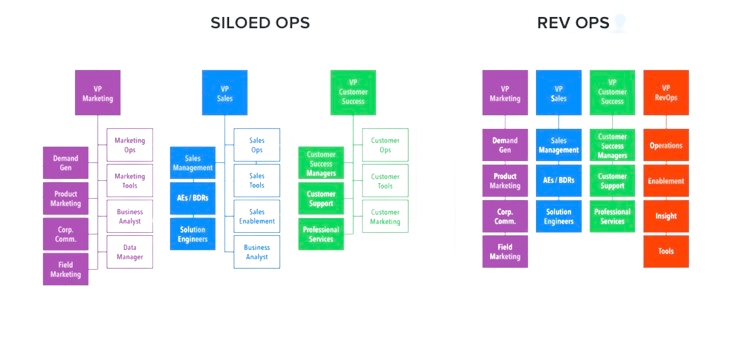
Marketing Ops and Sales Ops focus on individual teams. Revenue operations sits above both, connecting them to customer success and finance while tying all activity to revenue outcomes.
Marketing Ops concentrates on campaign execution, lead scoring models, demand generation attribution, and marketing tools like Marketo or HubSpot Marketing Hub. The goal is optimizing marketing-qualified leads and proving marketing ROI through multi-touch attribution.
Sales Ops handles sales-specific levers: territory assignments, quota distribution, pipeline hygiene (stage progression rules in Salesforce), sales enablement content, and forecasting tied to rep-submitted pipelines. Sales operations teams often struggle with forecast accuracy, sometimes seeing variance exceed 20% due to siloed inputs.
RevOps overlays a company-wide layer that standardizes data definitions (uniform lifecycle stages across tools), processes (end-to-end handoffs with documented SLAs), and technology stack management (bi-directional syncs between CRM, marketing automation, and CS platforms). Everything ties to revenue metrics: ARR growth, NRR, and CAC payback.
Here’s a concrete example: A revenue operations agency might redesign lead routing in HubSpot or Salesforce to minimize MQL-to-SQL leakage, a common issue where 30-50% of marketing qualified leads fail to convert due to poor handoff processes. By standardizing SLAs between SDRs, AEs, and customer success teams, the agency creates measurable improvements like 10-20% increases in qualified pipeline volume. Traditional ops silos can’t address this because they optimize their piece without seeing the full funnel.
Core Services Offered by RevOps Agencies
Most RevOps agencies organize services around four pillars: strategy, process, technology, and analytics. These are delivered as one-time projects such as CRM migration services (like a 60-120 day HubSpot migration) or ongoing retainers (RevOps-as-a-Service with monthly backlogs).
The services below represent typical offerings—not every agency covers all areas, and many now layer AI capabilities like forecasting models, next-best-action scoring, or AI assistants for pipeline reviews.
Strategy & GTM Architecture
RevOps agencies design end-to-end revenue blueprints that connect board-level targets to operational execution. This includes ICP refinement, market segmentation, SLA frameworks, and funnel definitions.
Typical outputs include a 12-18 month revenue architecture roadmap, lead qualification frameworks, and conversion benchmarks calibrated for 2026 B2B SaaS (think 25-40% MQL-to-SQL rates, 25-35% win rates for enterprise sales). Strategy work usually starts with 2-3 week discovery sprints involving stakeholder interviews across marketing, sales, and customer success operations.
The core focus: connecting what the board cares about (ARR, NRR, CAC payback) to what ops teams control (conversion rates, sales cycle length, win rates). Strategic guidance without this connection produces decks that collect dust.
Process Design & Optimization
Process work addresses the workflows that determine how revenue teams operate daily. Common engagements include lead routing optimization, opportunity stage redesign, renewal and expansion motions, and CS playbook development.
A concrete example: redesigning a 7-stage Salesforce opportunity pipeline with clear exit criteria at each gate, or standardizing renewal workflows for 12-month contracts to reduce churn via automated alerts. Process optimization also documents SLAs between SDR, AE, and CSM teams—specifying response times, handoff protocols, and escalation paths.
Measurement matters here. Strong revops consultants validate process changes with A/B tests, before/after funnel metrics, and cohort analyses showing 10-15% improvements in response times and funnel velocity.
Tech Stack Implementation & Integration
Tech stack work focuses on revenue systems architecture: CRMs (Salesforce, HubSpot), marketing automation platforms (Marketo, Pardot), CS tools (Gainsight, Catalyst), and data warehouses (Snowflake, BigQuery).
RevOps agencies handle multi-system integrations—Salesforce plus HubSpot plus NetSuite with data quality automation like deduplication—and clean up overlapping tools accumulated during 2020-2024 growth phases. Deliverables include data schemas, field governance rules, routing logic, scoring models, and integration runbooks.
Recent themes for 2025-2026: consolidating point solutions to reduce costs ($50K-100K annual savings is common), moving to AI-native platforms, and enforcing single source of truth via centralized warehouses. CRM implementation done right prevents the technical debt that stalls rapid growth.
Analytics, Forecasting & Attribution
Analytics work delivers the dashboards and reports leadership needs for decision-making. Key views include pipeline coverage (ideal 3-4x), forecast accuracy (target under 15% variance), NRR trending, logo vs. expansion growth, and CAC payback by segment.
Agencies build these in tools like Looker, Tableau, Power BI, or CRM-native dashboards. For data analytics beyond basic reporting, they implement multi-touch attribution connecting ad platforms, marketing automation, and CRM to show which programs drive opportunities and ARR—often using dbt transformations in Snowflake or BigQuery.
Forecasting outputs include weekly forecast call frameworks, AI-assisted forecasts compared to rep-submitted numbers (expect 10-20% initial differences), and scenario planning by segment or region. Accurate forecasting enables the predictable growth investors demand.
 When Should You Hire a RevOps Agency?
Several symptoms indicate you need external RevOps help. If pipeline growth has stalled despite marketing spend, if forecast variance exceeds 20%, if marketing attribution remains unclear, if lead response times exceed 5 minutes, or if churn is rising above 10% annually—these are signals that internal operations need reinforcement.
RevOps agencies complement in-house teams in three ways: as a full outsourced function (complete RevOps team via retainer), as a fractional extension (part-time VP RevOps for strategic alignment), or as project specialists (90-day audits and implementations).
Common scenarios include: a Series A-B SaaS company at $5-20M ARR without dedicated ops headcount; a mature company with messy Salesforce after 3+ acquisitions; or a PLG startup layering on sales in 2025-2026 and needing to bridge self-serve metrics to enterprise deal tracking.
By Company Stage & GTM Maturity
Early-stage (Seed–Series A): Teams typically need foundational systems, baseline reporting, and simple processes. Engagements run 3-6 months, focusing on HubSpot setup, basic dashboards, and documented workflows. The goal is establishing a foundation for scalable growth.
Growth-stage (Series B–D): Companies seek scalable architectures, multi-region support, and advanced attribution/forecasting. A 12-month RevOps-as-a-Service retainer might include ongoing optimization, quarterly roadmap reviews, and continuous experimentation.
Late-stage and PE-backed firms (2024-2026): Emphasis shifts to operational efficiency, deal desks, margin controls, renewal/expansion rigor, and cost-per-tool rationalization. A 90-day RevOps audit followed by targeted implementation addresses specific revenue optimization opportunities.
By Internal Capacity & Skill Gaps
Evaluate your RevOps bandwidth by comparing GTM tool count, regions served, and team size against dedicated ops headcount. A company running 15+ tools across 3 regions with one ops generalist has a clear capacity gap.
Common skill gaps agencies fill include complex Salesforce development (Apex triggers, custom objects), data engineering (Snowflake pipelines), revenue analytics (cohort NRR tracking), and enterprise-grade process design.
Consider this framework: if you rely heavily on HubSpot but lack architecture expertise, look for HubSpot Elite-level partners. If you need Salesforce-to-NetSuite integration but lack developer capacity, prioritize technical execution capability. If leadership alignment is the bottleneck, seek fractional RevOps leaders who provide strategic consulting alongside operational execution.
How to Evaluate and Compare RevOps Agencies
Not all RevOps companies are equal. Some specialize in HubSpot, others in Salesforce. Some focus on PLG motions, others on enterprise sales-led models. Choosing the right RevOps agency requires matching capabilities to your specific context.
Key evaluation dimensions include specialization (industry, revenue model, tools), engagement model (project vs. retainer), proven results (case studies with metrics), and cultural fit (communication style, willingness to challenge).
Use real proof during evaluation: case studies showing 15-25% sales cycle reductions or 20% pipeline growth matter more than polished pitch decks. Client retention above 80% indicates agencies that deliver ongoing value.
Industry, Revenue Model & Tooling Fit
SaaS, fintech, and services firms have different needs. Usage-based billing requires different tracking than seat-based ARR or project-based revenue. A RevOps consultancy experienced in your specific model will ramp faster.
Seek agencies with hands-on experience in your revenue model (subscription, marketplace, PLG, consumption-based) and geographic footprint (North America, EMEA, APAC). Tool specialization matters too: some agencies work exclusively with Salesforce, others are HubSpot-centric, and some are platform-agnostic supporting 150+ integrations.
Check whether the agency has worked with companies at similar ARR bands and sales motions. An agency experienced with $10-50M sales-led companies may not be the right RevOps partner for an early-stage startup running founder led sales.
Engagement Model, Pricing & ROI
Typical 2026 models include project-based engagements ($50K-200K over 60-120 days), fractional RevOps ($10K-25K/month embedded), and RevOps-as-a-Service ($20K+/month ongoing team subscription). Managed services retainers suit companies wanting continuous optimization without full-time hires.
Frame ROI concretely. If increasing MQL-to-opportunity conversion by 5 points generates $500K+ additional quarterly pipeline for a company already producing $10M pipeline per quarter, the investment math becomes clear. Faster ramp to accurate reporting, improved conversion rates, shorter sales cycles, and lower tool spend are all measurable revenue outcomes.
Team Seniority, Process & Communication Style
Ask who will actually do the work, senior architects or junior admins executing playbooks. The difference matters enormously for strategic alignment and driving revenue growth.
Ideal collaboration cadence includes weekly standups, monthly QBRs, shared Slack channels, and clearly documented backlogs. By 2026, top agencies bring their own playbooks, templates, and migration checklists rather than reinventing from scratch. This accelerates time-to-value and reduces project based engagements risk.
Evaluate cultural fit carefully. The best RevOps partner offers transparency about tradeoffs and willingness to push back when a request harms long-term architecture. Agencies that say yes to everything often create technical debt that undermines revenue enablement goals.
What to Expect from a RevOps Engagement (Typical Timeline & Deliverables)
Most RevOps projects run through four phases: discovery, design, implementation, and enablement/iteration.
A typical 90-day engagement follows this structure:
|
Phase |
Timeline |
Activities |
|---|---|---|
|
Discovery |
Weeks 1-2 |
Stakeholder interviews, data audits (often revealing 20-30% duplicate records), current-state documentation |
|
Design |
Weeks 3-4 |
GTM architecture blueprint, SLA frameworks, system design |
|
Implementation |
Weeks 5-10 |
CRM builds, integrations, workflow automation, dashboard development |
|
Enablement |
Weeks 11-12 |
Training sessions, playbook documentation, change management plans |
Common deliverables include RevOps audit reports (50+ page gap analyses), GTM architecture diagrams, field and object schemas, routing rules, 10-15 core dashboard views, and operational documentation.
Ongoing retainers differ by adding continuous backlog management, new experiments (like AI-based scoring pilots in mid-2025), and quarterly roadmap reviews. This model suits growth stage companies prioritizing continuous optimization over one-time fixes.
Metrics & Outcomes You Should Track
Track 8-10 core KPIs to judge RevOps agency impact:
- MQL→SQL conversion (target 25-40%)
- SQL→opportunity conversion (60-80%)
- Win rate (25-35% for enterprise)
- Sales cycle length (90-120 days)
- Average contract value
- Net revenue retention (110-130%)
- Churn rate (under 8%)
- Forecast accuracy (under 15% variance)
Time-to-value matters. Expect first reporting clarity within 30-45 days and early pipeline performance improvements within 60-120 days. Before/after snapshots comparing pipeline by stage, engagement by channel, and renewal rates across quarters demonstrate concrete impact.
Companies commonly see 10-20% increase in qualified pipeline once routing and lead scoring are fixed. These gains compound: better routing means faster response, which means higher conversion, which means more revenue generation from the same marketing spend.
Future of RevOps Agencies: AI, Automation & Autonomous GTM
RevOps is shifting from manual reporting to AI-assisted and partially autonomous operations. This changes what agencies deliver and how they measure impact.
Agencies in 2025-2026 are deploying AI tools across the revenue cycle: predictive forecasting (accuracy gains of 15-25% over manual methods), AI SDR agents (automating 30% of outreach), conversation intelligence (automated call scoring), and autonomous pipeline checks (flagging stalled deals within 7 days).
Examples of AI-native RevOps tools include conversation intelligence platforms that score calls automatically, predictive scoring models that prioritize accounts, AI SDR agents that handle initial outreach, and autonomous systems that maintain pipeline hygiene without human intervention.
Agencies increasingly act as orchestrators of AI plus human workflows—deciding where to automate, how to govern data, and how to measure impact through controlled experiments (A/B testing next-best-actions can lift conversions 12%). But AI amplifies garbage-in-garbage-out risks. Without clean CRM data, standardized objects, and clear definitions, AI tools produce unreliable outputs.
The RevOps team of 2026 isn’t just configuring workflows, it’s designing human-AI collaboration models that maintain data quality while scaling operational execution.
Conclusion: Making a Strategic Bet on the Right RevOps Agency
RevOps agencies in 2026 are not extra admins. They’re strategic partners that design and operate your entire revenue engine, connecting marketing alignment, sales operations, and customer success into unified revenue operations solutions.
Choosing the right agency requires clarity on your stage, specific RevOps challenges, tech stack, and desired revenue outcomes. Early stage startups need foundations; growth companies need scale; PE-backed firms need efficiency. Match the agency’s strengths to your needs.
Before signing any contract, define success metrics: which KPIs must move in the next 6-12 months? What constraints (budget, tools, headcount) are you working within? Revenue operations excellence comes from measurable improvement, not activity.
Think of RevOps as an operating system for go to market teams. The companies investing in solid RevOps foundations now, streamlining revenue operations, implementing scalable solutions, and building for AI-native workflows, will outpace competitors over the next 3-5 years. The question isn’t whether you need RevOps capability. It’s whether you build it internally or partner with a RevOps agency that accelerates your path to sustainable growth.
Key Takeaways
-
Several leading RevOps agencies, such as Elefante RevOps, Winning by Design, and Avidly Agency, specialize in optimizing revenue strategies, sales and marketing alignment, and leveraging technology to drive sustainable growth for B2B SaaS companies.
-
RevOps agencies like offer comprehensive services including CRM migrations, technology implementation, and data-driven strategies to optimize the customer lifecycle and enhance overall business performance.
-
Hiring a RevOps agency can provide strategic planning, expert guidance, and additional resources to overwhelmed internal teams, ensuring seamless collaboration and improved revenue performance across sales, marketing, and customer success operations.
-
Hiring a RevOps agency can improve operational efficiency.
Frequently Asked Questions
What is a RevOps agency?
A RevOps agency maximizes revenue potential by aligning marketing, sales, and customer service operations to optimize sales and, leveraging data and technology to generate demand, optimize sales, and drive growth and profitability.
When should a company hire a RevOps agency?
A company should hire a RevOps agency when internal teams are overwhelmed, lack expertise, or need guidance for complex implementations and revenue improvement. Engaging them in advance allows for strategic planning and proactive solutions.
How does RevPartners.io differentiate itself from other RevOps agencies?
RevPartners.io differentiates itself from other RevOps agencies by prioritizing sustainable growth and data-driven decisions, focusing on HubSpot CRM, migrations, and implementations, and offering RevOps as a Service that includes tech stack audits and automation build-outs.
This allows for accelerated growth and measurable, actionable, and repeatable revenue growth.
What services does Digitopia offer to B2B SaaS companies?
Digitopia offers revenue strategy development, sales and marketing alignment, process optimization, technology implementation, and data analytics to B2B SaaS companies, aiming to create predictable growth and deliver true ROI.
Why is sales and marketing alignment important in RevOps?
Sales and marketing alignment in RevOps is important because it ensures that both departments work together towards common revenue goals by automating sales through, optimizing the customer experience and thereby up conversion rates, optimizing customer lifecycle management and maximizing revenue generation.
This ultimately creates a seamless customer journey and enhances efficiency.