



.svg)



.svg)


.svg)


Moving your CRM isn’t just about copying records from one system to another. It’s about evolving how your team sells, markets, and serves customers.
This guide walks you through the entire migration journey from Pipedrive to HubSpot, covering strategy, data migration, mapping, testing, and team training. Serving as a step by step guide, it ensures you follow a clear, sequential process for a successful migration. You’ll learn how to seamlessly migrate without losing deal history, breaking your sales pipeline, or confusing your team.
Overview: Why switch from Pipedrive to HubSpot in 2026?
Teams are leaving Pipedrive for HubSpot in 2026 for three core reasons: they’re scaling past 5-10 sales reps, marketing needs full-funnel attribution, and service teams want unified customer data. Pipedrive excels at simple sales pipelines, but it wasn’t built to unify marketing automation, service tickets, and revenue reporting under one platform.
The concrete benefits of HubSpot CRM include unified marketing-sales-service data in a single database, advanced automation features across the full customer lifecycle, and multi-touch attribution that ties campaigns directly to closed revenue. Teams report an 86% improvement in lead quality through advanced lead scoring and cross-functional workflows. Over 2-3 years, consolidating 3-5 disparate tools into HubSpot often lowers total cost of ownership.
A typical small-to-mid migration today covers 20k-200k records and takes 4-12 weeks depending on complexity. Fast-track projects with simple setups under 10k records can compress to 2-3 weeks.
The main phases of a successful migration include:
- Strategy and stakeholder alignment
- Data auditing and cleaning
- Field-to-property mapping
- Iterative test migration runs
- Final cutover with freeze periods
- Phased onboarding and team training
Pipedrive to HubSpot: impact on teams, process, and collaboration
This crm migration is not just a technical copy-paste of your existing data. It’s an organizational shift in how marketing, sales, and service collaborate around a shared customer platform.
Pipedrive functions as a sales-only CRM optimized for deal pipelines and activity reminders. HubSpot centralizes contacts, companies, deals, tickets, and marketing assets in one platform, reshaping how teams meet, report, and hold each other accountable.
Consider this scenario: a B2B SaaS company with 6 sales reps and 2 marketers moves from Pipedrive plus a separate email tool into HubSpot Sales & Marketing Hub Pro. After migration, their weekly meetings now include real-time attribution linking webinar leads to Q2 closes. Shadow spreadsheets disappear because native forms and knowledge bases live inside HubSpot. Revenue per rep increases through tighter marketing-sales alignment.
Getting cross-functional buy-in before migration day matters enormously. Companies that demo unified reporting to stakeholders pre-migration see 30-50% higher user adoption rates because teams visualize exactly how fragmented Pipedrive data evolves into actionable insights.
Top reasons to migrate from Pipedrive to HubSpot
This section covers the strategic “why” behind the move, not a feature dump, but the concrete business outcomes that justify the effort.
Reason 1: Full-funnel marketing and service integration
Pipedrive focuses on sales pipelines. HubSpot combines customer relationship management with marketing automation (email sequences, forms, ads, landing pages) and service tools (ticket pipelines, knowledge bases, customer surveys) in one database, resulting in seamless integration of sales, marketing, and service workflows.
A lead can move from anonymous website visitor to closed customer to advocate entirely inside HubSpot. Marketing teams build lead nurturing workflows and lead scoring. Service teams manage ticket SLAs and self-service content. No more manual exports from Pipedrive into disconnected email tools.
Reason 2: Better data, reporting, and attribution
Fragmented data across email tools, Google Sheets, and Pipedrive makes it nearly impossible to see which campaigns actually drive revenue. HubSpot offers multi-touch revenue attribution in Marketing Hub Pro/Enterprise, custom dashboards per team, and deal attribution that connects activities to outcomes.
Concrete example: you can tie February 2026 webinar registrations directly to deals won in Q2 2026. This means cleaner forecasts, clearer ROI calculations, and more confident budgeting decisions.
Reason 3: Scalability, flexibility, and automation
Pipedrive’s simplicity becomes a limitation when you need complex workflows, territory management, or multi-region operations. HubSpot scales from a 3-person startup to hundreds of seats with advanced permissions, teams, custom properties, and custom objects.
Scaled workflow examples include automatic lead routing by region, SLA enforcement on support tickets, renewal reminders, and upsell sequences. Many companies in 2024-2026 are consolidating tech stacks, and HubSpot often replaces 3-5 separate tools plus Pipedrive.
Planning your Pipedrive to HubSpot migration
The plan matters more than the migration tools you use. Poor planning leads to duplicate records, missing engagement history, and user revolt. A typical recommendation is 8-12 weeks end-to-end, though fast-track projects can run 2-3 weeks for simple setups.
A sample timeline looks like this: Weeks 1-2 focus on discovery and data audit, Weeks 3-4 on mapping and HubSpot configuration, Weeks 5-6 on test migration and validation, and Weeks 7-8 on go-live and team training. Minimize license overlap by setting a clear cutover date and freezing structural changes in Pipedrive (pipelines, custom fields) shortly before final migration.
Defining scope, success criteria, and non-negotiables
Decide early which data types and business processes are in scope for phase 1 versus later optimization. Start with contacts, companies, and deals. Save custom objects for a later phase. Identifying and managing distinct record types, such as contacts, deals, or custom objects, is crucial for accurate data mapping and a seamless pipedrive to HubSpot migration.
Measurable success criteria keep the project grounded:
- Less than 5% duplicate contacts post-migration
- All open deals visible in the new HubSpot environment
- 90% of team training completed before cutover
Document existing workflows you must preserve: how deals get created, how activities are tracked, and which reports leadership reviews weekly. Map these non-negotiables to HubSpot capabilities early so you don’t discover gaps two days before go-live.
Choosing your migration approach: DIY vs. external partner
Three approaches exist for moving data between systems:
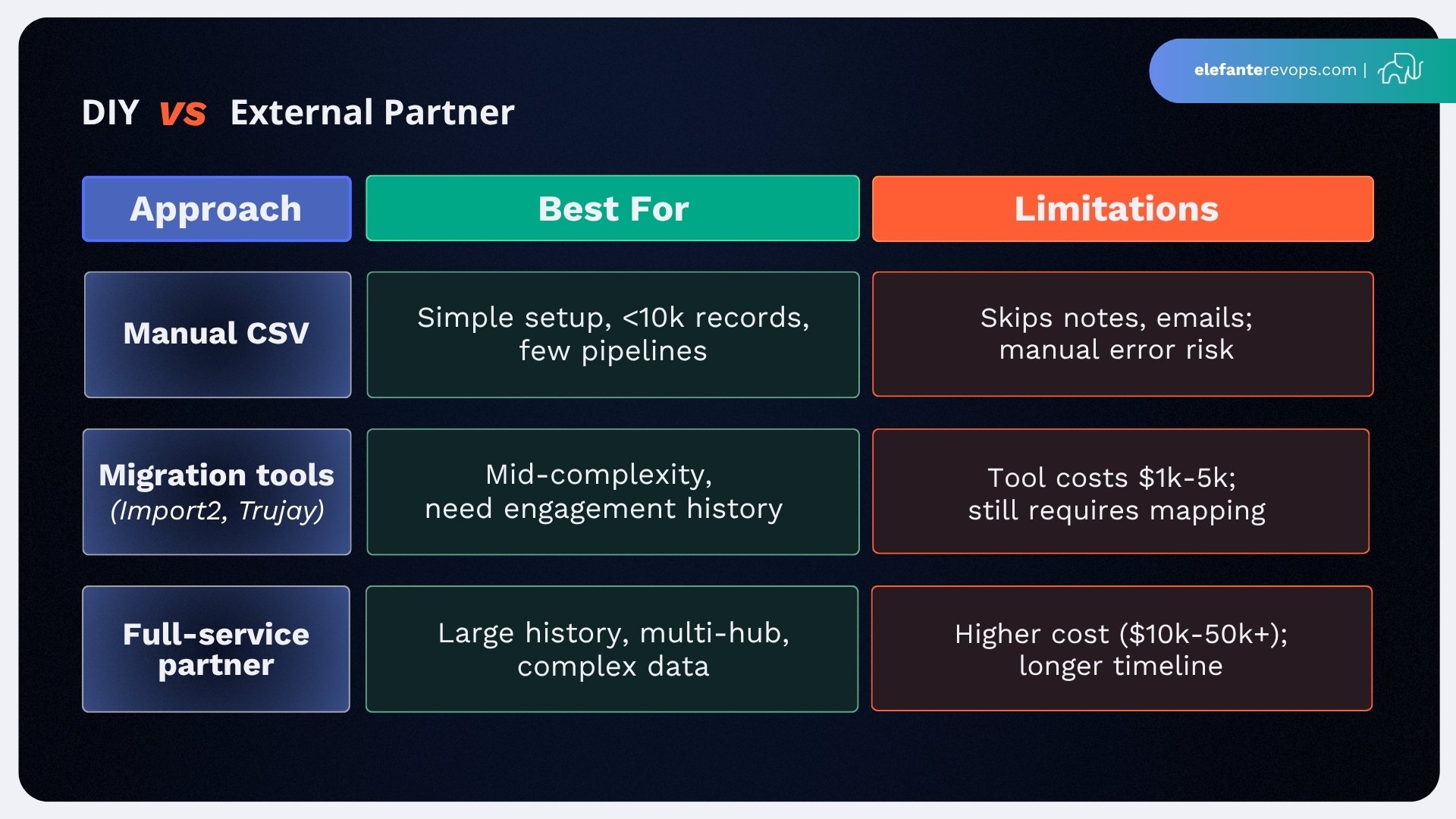
Factor in hidden costs: internal time spent on rework, potential sales downtime if something breaks, and the learning curve for third-party tools. Many companies pair HubSpot-led onboarding with CRM migration services to cover both strategy and technical execution.
Understanding the HubSpot environment and key features
A successful migration from Pipedrive to HubSpot starts with a solid understanding of the HubSpot environment and its core capabilities. HubSpot offers a unified platform that brings together sales, marketing, and customer service, allowing your teams to collaborate seamlessly and access the same data in real time.
Key features of the HubSpot environment include advanced customization options for pipelines and dashboards, robust marketing automation tools, and powerful analytics for tracking performance across your entire customer journey. HubSpot’s CRM is designed to be intuitive, yet flexible enough to support complex business processes and custom fields, making it easy to adapt to your organization’s unique needs.
Familiarizing yourself with HubSpot’s sales, marketing, and service tools before starting the migration process will help ensure a smooth transition. Take advantage of HubSpot Academy resources, explore the platform’s automation features, and review how data is structured within the new HubSpot environment. This foundational knowledge will empower your team to leverage everything HubSpot offers and set the stage for a successful migration.

Preparing and cleaning your Pipedrive data
The migration process is the best moment in years to clean up your CRM. Garbage in, garbage out applies directly here.
Key data domains you’ll touch include people (contacts), organizations (companies), deals, activities (tasks, calls, emails, meetings), notes, files, and custom fields. This cleaning should happen predominantly inside Pipedrive CRM before any export.
Use a specific snapshot date for stability, for example, “We audited all Pipedrive data as of May 1, 2026”, to avoid a constantly moving target during the entire migration.
Data auditing and deduplication
Start by exporting samples from Pipedrive. Identify duplicate contacts (same email), duplicate companies (same domain), and conflicting field formats.
Define consistent formatting rules:
- Phone numbers: +1-555-123-4567 format
- Country names: Full names, not abbreviations
- Deal stages: Standardized naming across teams
- Owner fields: Current employees only
Create rules for outdated information, archive deals closed before 2020, remove bounced emails, merge duplicate organizations. Use Pipedrive’s built-in merge features, Excel filters, or lightweight dedupe tools before exporting.
Prioritizing what to migrate (and what to leave behind)
You don’t need to migrate everything ever created. Focus on high-value and recent data to maintain data accuracy without importing a decade of noise.
Priority list for phase 1:
- All active contacts and those with activity in the last 18-24 months
- All deals since January 2022
- Notes tied to current customers
- Mission-critical custom fields that drive segmentation or automation
Consider leaving full activity history (every call, email, task) in Pipedrive as an archived reference. This reduces cost, complexity, and import data volume while preserving access to critical information through read-only Pipedrive access.
Mapping Pipedrive to HubSpot: objects, properties, and structure
Core Pipedrive objects map to HubSpot objects like this:
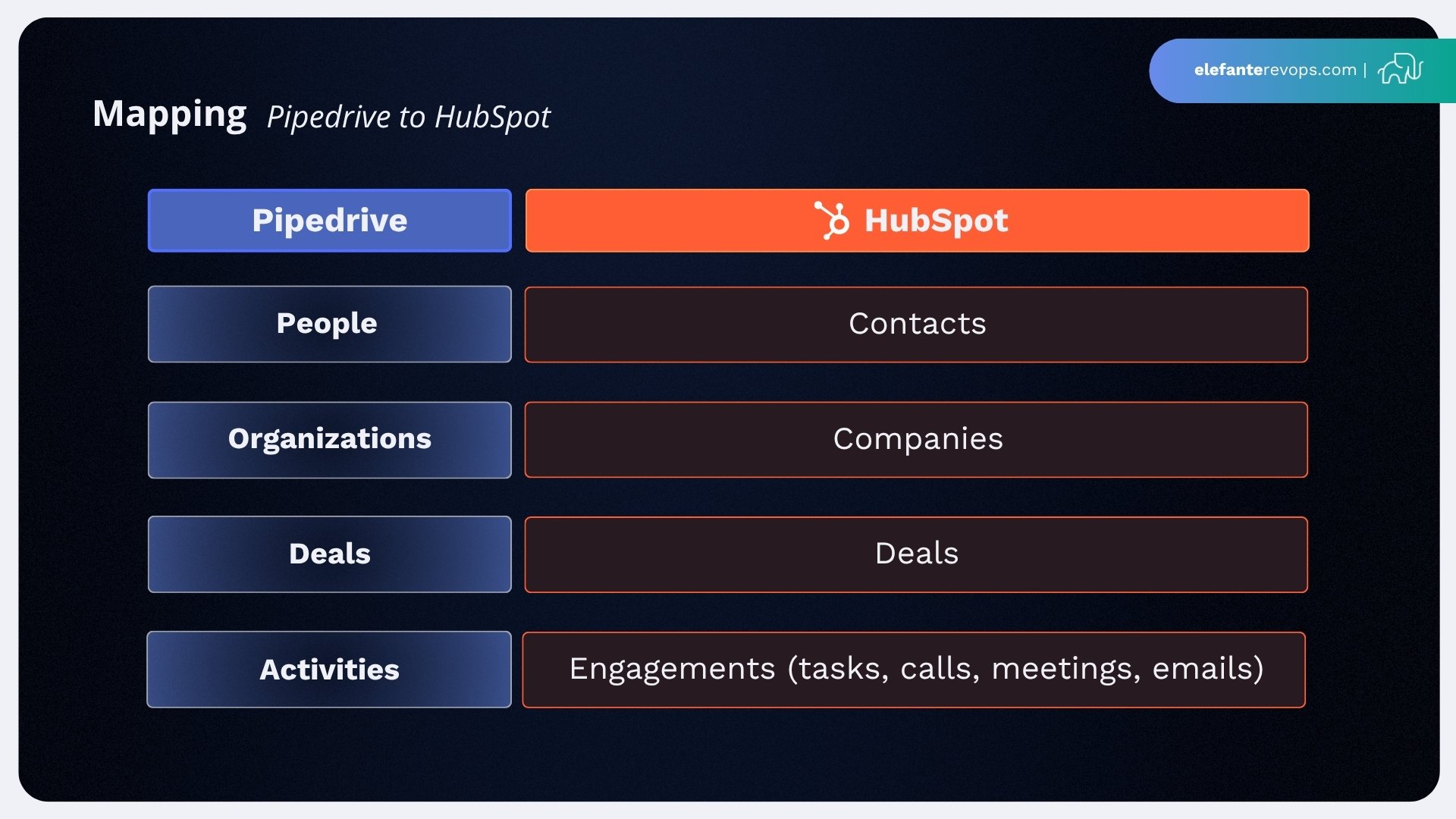
Create a data mapping workbook (spreadsheet) listing each Pipedrive field, its data type, and its HubSpot destination. This becomes your source of truth throughout the migration.
Common pitfalls include many-to-one fields, multi-selects that don’t translate cleanly, custom stages needing normalization, and free-text status fields requiring cleanup. HubSpot’s data structure introduces concepts like Lifecycle Stage, Lead Status, and Associations, design these intentionally rather than accepting defaults.
For HubSpot Enterprise customers, custom objects can absorb specialized Pipedrive data (subscriptions, projects, shipments) that was stored via workarounds.
Designing your HubSpot data model
Sketch how Contacts, Companies, Deals, and Tickets will relate in the new system, independent of current Pipedrive limitations.
Decide on core segmentation fields early, industry, company size, region, lifecycle stage, lead status, because these drive marketing automation and reporting later. Plan association rules: which deals connect to which companies and contacts, and how you’ll handle multi-contact deals.
Align naming conventions (deal stages, pipelines) with your sales methodology. This makes user adoption significantly easier.
Configuring HubSpot properties for migrated data
Create custom properties in HubSpot to receive Pipedrive data fields that don’t have native equivalents.
Property type mapping:
- Text fields → Single-line or multi-line text
- Numbers → Number properties
- Dates → Date picker properties
- Dropdowns → Dropdown select
- Multi-select → Multiple checkboxes
Group custom properties logically, “Pipedrive Legacy Data,” “Billing,” “Product Interest”, to keep the HubSpot environment tidy. Some Pipedrive fields work better as HubSpot workflows or picklists rather than 1:1 text fields. For example, a “Status: Hot/Warm/Cold” text field becomes a dropdown with automation triggers.
Migrating third-party integrations and apps
Migrating third-party integrations and apps is a crucial part of the migration process that ensures your business processes remain seamlessly integrated after moving to HubSpot. HubSpot offers an extensive integration directory, supporting connections with popular tools for email, marketing, finance, project management, and more.
Begin by auditing your current integrations in Pipedrive and identifying which apps are essential for your workflows. Next, check HubSpot’s integration marketplace to confirm compatibility or explore API options for custom connections. Many integrations can be set up directly within HubSpot, while others may require third-party migration tools or technical expertise.
After connecting your apps and services, thoroughly test each integration to confirm data is syncing correctly and workflows are functioning as expected. This careful approach ensures a seamless transition, minimizes disruption to your business processes, and allows your team to continue working efficiently with the tools they rely on. Remember, a well-executed integration migration is key to unlocking the full value that HubSpot offers.
Executing the migration: from test imports to go-live
Always run one or more pilot migrations before the final cutover. Test before you move everything.
Main execution steps include exporting Pipedrive data, transforming and cleaning via your mapping workbook, importing into HubSpot (or running the migration tools), validating results, fixing issues, and re-running if needed.
Most teams do at least one dry run in a sandbox or using a subset of data in the production portal. Schedule the final migration during a low-activity period, a weekend or quiet week, to avoid interrupting live deal work.
Exporting data from Pipedrive safely
Export each record type from Pipedrive as separate CSV files, such as contacts (People), companies (Organizations), deals, activities, and notes. Properly organizing these record types ensures accurate data mapping and property configuration during your pipedrive to HubSpot migration. Be sure to include unique identifiers (Pipedrive IDs, email addresses, company domains) to help with re-association in HubSpot.
Verify export completeness by comparing record counts in Pipedrive versus the CSV file output before proceeding. Store a full, read-only data backup dated (e.g., “Full backup taken 10 June 2026”) as a safety net for any rollback needs.
Running a test migration and validating results
A test migration typically involves 500-2,000 records across all main object types to validate mappings and associations.
After the test, check:
- Field values match expected data
- Deal stages mapped correctly
- Contact-company-deal associations work
- Owner assignments are accurate
- Sample engagement history appears
Build a small validation checklist with real users, two sales reps and one manager reviewing their own accounts and deals. Correct mapping issues and re-run test imports until the data in HubSpot looks clean. Thorough testing prevents data loss and ensures data integrity.
Final cutover and handling “day one” in HubSpot
The final migration run follows a specific sequence: freeze edits in Pipedrive (no pipeline or field changes), run the final cutover during low-activity hours, then switch teams to HubSpot the next business day.
Clear internal communication about the cutover date, blackout periods, and where to log new sales activities prevents confusion. Keep Pipedrive in read-only mode for 30-90 days after go-live so teams can look up legacy details when needed.
Run spot checks on day one and week one: sample records, core reports, and sales pipeline views. This validates the smooth transition.
Maintaining business continuity during migration
Ensuring business continuity during the migration process is essential to minimize downtime and keep your sales team productive. The best approach is to plan the migration in phases, starting with non-critical data and systems before moving on to core components. This phased strategy allows you to identify and resolve any issues early, reducing the risk of disruptions as you transition to the new system.
Clear communication is vital, keep your team and stakeholders informed about the migration timeline, what to expect, and any temporary changes to workflows. Assign point people to address questions and provide support throughout the process. By maintaining open lines of communication and executing the migration in manageable stages, you can ensure a smooth transition and minimize downtime for your sales team.
Ultimately, prioritizing business continuity during migration helps your organization maintain momentum, protect data integrity, and ensure that your team can continue to operate effectively throughout the migration process.
Rebuilding pipelines, dashboards, and reports in HubSpot
This is the “recreate, not clone” phase. Pipedrive pipelines and reports won’t transfer 1:1, and that’s actually an opportunity.
Use this moment to improve your sales process: adjust deal stages based on actual win rate data from Pipedrive, simplify pipelines, and align naming across different departments. Prioritize a small set of mission-critical dashboards for launch rather than rebuilding everything at once.
Designing and configuring HubSpot sales pipelines
Translate current Pipedrive pipelines into HubSpot pipelines, mapping each stage and adjusting naming where it makes sense. Review win rates and stage duration data from Pipedrive before finalizing HubSpot stage definitions.
Configure HubSpot deal settings: stage probabilities for forecasting, automation (tasks created on stage change), and required fields at closing stages. Keep the number of stages manageable, 6-8 stages per pipeline improves both forecasting accuracy and team adoption.
Building dashboards and key reports in HubSpot
Essential dashboards to rebuild include:
- Pipeline overview
- Rep performance
- Sales forecast
- Marketing funnel
- Activity tracking
- New vs. returning customers
Use HubSpot’s reports library as a starting point, then customize filters and visualizations to match leadership expectations. Share and schedule reports to stakeholders so they see data from the new CRM early and often.
Compare Pipedrive’s historical metrics to new HubSpot dashboards for a few weeks. This validates data consistency and builds trust in the new system.
Optimizing your sales and marketing strategy in HubSpot
Once your data and processes are live in HubSpot, it’s time to optimize your sales pipeline and marketing strategy to fully leverage the platform’s capabilities. Start by reviewing your existing sales and marketing workflows to identify bottlenecks or areas for improvement. HubSpot’s marketing automation features allow you to personalize campaigns, automate lead nurturing, and segment audiences for more targeted outreach.
Use HubSpot’s sales tools to refine your sales pipeline, set up automated task reminders, and track deal progress with greater accuracy. Take advantage of built-in analytics to monitor conversion rates and identify high-performing strategies. By continuously optimizing your marketing strategy and sales process within HubSpot, you can increase efficiency, improve lead quality, and drive more revenue.
Remember, HubSpot is more than just a tool, it’s a platform designed to help you align your sales and marketing teams, automate repetitive tasks, and deliver a seamless customer experience from first touch to closed deal.
Onboarding, training, and adoption in HubSpot
Even a flawless data migration fails if the team doesn’t use HubSpot consistently. The difference between system setup and human adoption determines whether this becomes successful adoption or expensive shelfware.
Treat HubSpot onboarding as a 60-90 day program rather than a one-off training session. Resources available in 2026 include HubSpot Academy certifications, in-app guides, and office hours with admins or partners. Measure adoption via activity logs, login frequency, and data completeness targets.
Designing a practical HubSpot training plan
Segment team training by role, SDRs focus on CRM hygiene, AEs on pipeline management, managers on reporting, marketers on automation features. Each group needs tailored sessions focusing on their daily workflows.
Sample plan:
- Week 1: Basic navigation and CRM hygiene
- Week 2: Pipeline management and deal tracking
- Week 3: Reports, views, and dashboards
- Week 4: Automation and sequences
Use live demos with actual migrated data so the system feels real and relevant from day one. Appoint “HubSpot champions” in each team who can answer questions and collect improvement ideas for ongoing support.
Supporting change management and long-term adoption
Leadership should explain why the company is moving to HubSpot and how it helps each team hit their targets. Update sales playbooks, SLAs, and KPIs to reference HubSpot dashboards instead of legacy Pipedrive language.
Run weekly feedback loops for the first 4-6 weeks after go-live to quickly fix friction points like missing data fields or confusing views. Quarterly reviews of HubSpot usage and data quality keep the system healthy over time.
Security, compliance, and risk management during migration
CRM data includes sensitive personal and commercial information. Migrating data between systems involves exports, temporary storage, and imports that must all be protected.
In 2026, GDPR, CCPA/CPRA, and regional privacy regulations affect how you handle this smooth data transfer. HubSpot provides encryption in transit and at rest, role-based access controls, and audit logs. But processes around the migration, your exports, staging files, and access permissions, also need data security attention.
Data protection, backups, and access control
Take a full export of Pipedrive data before migration and store it securely as a time-stamped backup. Restrict who can access raw exports and staging files during migration using least-privilege principles.
Document where data is stored temporarily (encrypted cloud storage) and when those files will be deleted. Review user permissions in HubSpot immediately after go-live to prevent over-exposed sensitive information like deal values or confidential notes.
Privacy, consent, and email compliance in HubSpot
Migrating contacts includes consent and subscription status. These must be mapped correctly to avoid sending non-compliant emails through HubSpot offers like email sequences.
Transfer unsubscribe and opt-out information from Pipedrive or external email tools into HubSpot’s subscription types. Set up cookie consent banners, GDPR features, and data retention policies in HubSpot straight after migration.
Critical pitfall to avoid: accidentally re-subscribing contacts who previously opted out during the import process. Validate subscription fields during your test migration to ensure the same data comes through correctly.
Best practices for a successful CRM migration
To achieve a successful CRM migration, it’s essential to follow proven best practices at every stage. Begin with a thorough assessment of your existing data, identifying and cleaning up duplicates, inaccuracies, and outdated information. This ensures that only high-quality data is imported into your new system.
Use structured data migration tools or CSV files to transfer your data, and always perform test migrations to validate that records are transferring correctly and maintaining their integrity. After the migration, review your data in HubSpot to confirm accuracy and completeness.
Support your team with comprehensive training on the new system, focusing on how to use key features and maintain CRM hygiene. Ongoing support and clear documentation will help drive successful adoption and maximize the value of your investment.
By following these best practices, careful planning, data cleaning, thorough testing, and strong user support, you can ensure a smooth CRM migration that positions your business for long-term success in your new HubSpot environment.
Frequently asked questions about Pipedrive to HubSpot migration
How long does a typical Pipedrive to HubSpot migration take? Simple migrations with under 10k records and basic pipelines typically take 2-3 weeks. Complex projects involving multiple pipelines, extensive engagement history, and multi-hub setups extend to 8-12 weeks end-to-end.
Can we migrate all our email and call history? Native CSV imports from Pipedrive don’t include engagement history. Third party tools like Import2 or Trujay can sync historical emails and calls, though very large attachments or email threads may require API batching.
Will my custom fields and pipelines map over automatically? No. Custom fields require manual recreation in HubSpot, and pipelines must be rebuilt. Your data mapping workbook defines how each Pipedrive field translates to HubSpot custom properties.
Can we run Pipedrive and HubSpot in parallel? Yes, for a short validation period. Many teams run both systems for 2-4 weeks during testing. Keep Pipedrive read-only after final cutover to reference legacy data without creating duplicate records.
What does a Pipedrive to HubSpot migration cost? DIY CSV migrations are essentially free beyond your time investment. Migration tools cost $1k-5k. Full-service CRM migration services charge $10k-50k+, depending on volume and complexity. Add HubSpot licensing costs (~$20-100/user/month) on top.
What’s the biggest risk during migration? Data loss and broken associations top the list. Mitigate these through thorough testing, multiple test migration runs, and maintaining a complete data backup. User resistance ranks second, counter this through early buy-in and structured team training.
How do we minimize downtime for the sales team? Schedule the final migration during a weekend or low-activity period. Freeze Pipedrive changes 48-72 hours before cutover. Communicate the timeline clearly so reps know exactly when to switch. Most teams experience less than one business day of reduced productivity.
The foundation of every successful migration comes back to three things: planning, data preparation, and testing, and all three are what a dedicated CRM migration service is built around. Get these right, and the rest follows naturally. Start with your data audit this week, your future HubSpot environment will thank you.