



.svg)



.svg)


.svg)


Most companies treat CPQ as a software purchase. They compare vendors, sit through demos, sign a contract, and expect quoting to fix itself. Then, months later, they discover the software was never the hard part. It was the catalog, the approval logic, and the billing handoff.
CPQ implementation is the process of modeling your product catalog, your pricing and discount rules, and your approval workflow, then wiring that logic into a platform (PandaDoc, Salesforce, HubSpot, or DealHub, among others) so your reps quote from one governed system instead of spreadsheets, email threads, and tribal knowledge. That order matters. You define the process, then you choose where to run it.
Buying a tool first and hoping it enforces a process you never wrote down is how reselling works, not how a RevOps partner works. Worth naming up front: roughly a third of the CPQ engagements teams take on start from zero tooling, and the rest are cleaning up a rollout that has already stalled. So "implementation" covers both the greenfield build and the rescue.
TLDR
- CPQ implementation means modeling your catalog, pricing, and approval logic before wiring it into a platform.
- Most rollouts fail because that groundwork gets skipped. The software almost always works fine.
- A simple build ships in 4-6 weeks; a complex one runs 14-24.
- Pricing falls into two models: phased ($10K–$30K/mo) or fixed-price (from $25,000).
- elefante runs CPQ implementations through a 5-stage process, starting with an assessment that tells you which end of that range you're on before you commit.
What Is CPQ Implementation?
CPQ stands for configure, price, quote: software that lets a rep assemble a product or bundle, apply the right pricing and discount rules, and generate an accurate quote without rebuilding it from scratch every time.
That's the definition, and if you're reading this, you probably already know it, so let's move on.
Here's the distinction that actually costs teams money: CPQ software and CPQ implementation are not the same thing. The software is the platform. The implementation is the work of translating a real product catalog, your discount and approval rules, and your downstream billing and contract logic into that platform so it holds up under actual deal volume. A platform ships empty. What you put into it, and how faithfully it mirrors the way you sell, decides whether reps trust it or route around it.
A real implementation has to get four things right.
- First, catalog modeling: your products, bundles, and options are represented as structured data instead of a shared spreadsheet three people have open at once.
- Second, pricing and discount logic: your tiers, your terms, and a clear map of who can approve what.
- Third, approval workflows that finance will actually sign off on, not a workaround they tolerate.
- Fourth, integration with CRM, billing, and contracting so a quote doesn't die at the handoff.
Skip any one of these, and you have a quoting tool with gaps your reps will find within a week. This CPQ implementation guide is built around getting all four right.
Why Most CPQ Implementations Fail
Name the villain plainly: the generic CPQ template. The one that treats every business like every other deal desk, drops in a copy-pasted price list, and calls it a configuration. It demos beautifully and survives contact with your actual pricing for about a quarter.
The Tool Is Almost Never the Reason
A large share of the revenue teams we talk to have already paid for one failed CPQ rollout. The pattern is almost always the same, and the tool is almost never the reason. The software worked fine. The catalog still lived in a spreadsheet, so quotes pulled stale prices. Approvals still happened in Slack, so there was no audit trail and no enforcement. Finance never got a workflow they trusted, so they kept their own shadow process to double-check every non-standard deal. The result is a tool that's technically installed and functionally shelved.
Generic Rollouts Skip Three Things Every Time
They skip a real product catalog modeled as structured data, settling for a price list pasted into new fields. They skip an approval flow finance will actually sign, because building one means sitting the deal desk and finance in the same room and agreeing on thresholds, and that's slower than shipping a demo. And they skip integration with billing and contracts, so a signed quote still gets rekeyed by hand and stalls at the handoff.
A Governance Gap the Software Was Never Configured to Lose
That last gap has a number attached to it. Unmanaged discount approval commonly costs 2% to 7% of margin per quarter when reps can self-approve, and finance can't trace the rule that priced a given deal. That's not a software failure.
A Failed CPQ Rollout Is Almost Never a Broken Platform
So reframe what "failure" means here. It's a process that was never designed before the tool was bought. Fix the process (catalog, approvals, integration), and the platform does what you paid for. That's the same critique that applies to a botched HubSpot rollout or a rushed CRM migration: the technology gets blamed for a planning problem.
Is CPQ Integration Complex?
Yes, and it's more honest to say so than to wave it off. The good news is that the complexity is predictable, because it comes from a specific place: how many systems your quote has to touch.
Three integrations do most of the work.
- CRM sync, so quotes pull live deal and contact data instead of a rep's copy-paste.
- Billing sync, so a signed quote becomes an invoice without anyone rekeying line items.
- Contract or e-signature handoff, so the terms in the quote match the terms in the signed agreement and don't drift in between.
The CPQ platform itself is rarely the bottleneck. The count of systems in play is what drives your timeline.
For a concrete sense of the ecosystem a CPQ implementation typically has to touch, here's the integration bench we work across: Stripe, Chargebee, and Recurly on billing and subscriptions; Segment, Snowflake, and BigQuery on data; Zendesk, Intercom, and Gainsight on the post-sale side; and HubSpot and Salesforce as the CRM systems of record. A quote that only syncs to CRM is a short project. A quote that has to be configured in CRM, priced against Chargebee, and hand-cleaned data to Snowflake for reporting is a longer one, and the difference is the integration surface.
One more thing worth saying, because it's usually the first thing that blocks a clean sync: your CRM data has to be trustworthy before CPQ can rely on it. Duplicate accounts, half-filled deal records, and inconsistent product fields will surface the moment quoting starts reading from them. If that's your starting point, sort the data first, often through dedicated CRM migration services, because a CPQ sync is only as clean as the records feeding it.
How Does CPQ Differ From Traditional Quoting Methods?
The default CPQ replaces quoting from spreadsheets, static PDF templates, or email threads where the pricing logic lives in one rep's head or a shared file three people are editing at once. It works until it doesn't, and it stops working exactly when you scale.
Four things change when you move to CPQ. Your line items come from a governed product catalog instead of being copy-pasted and quietly edited. Your pricing and discount rules get enforced by the system instead of being negotiated ad hoc on every deal. Your approvals run through a workflow with a visible audit trail instead of a Slack thread nobody can reconstruct later. And a signed quote hands off directly to billing and contracts instead of getting retyped into a second tool where terms drift. The practical payoff is that a quote means the same thing to sales, finance, and the customer, and you can trace how any deal got priced months after it closed.
The CPQ Implementation Process
We run CPQ implementations through the elefante Proven Process, a five-stage method built specifically so the catalog, approvals, and integrations get designed before anything gets built. The stages are CPQ Assessment, Catalog and Pricing Design, Build and Approval Flows, Test and Cutover, and Post-Launch Support.
It starts with the CPQ Assessment, a current-state audit of your products, price books, discount rules, and approvals, delivered as a written scope and a risk register that names the top failure modes before a single field gets configured. Then comes the Catalog and Pricing Design, where we map the catalog field by field, design the custom objects for products and discount tiers, and architect the CRM, billing, and contract integrations. That blueprint gets signed off by sales, deal desk, and finance together, because a catalog that only one team agrees with is a catalog that fails at approval.
Build and Approval Flows are the full build in your chosen platform, with parallel quote testing on production-scale data so you find the edge cases before your reps do. Test and Cutover is a validated switch with a documented rollback plan, and sales are trained before go-live rather than after. Post-Launch Support is 30 days of live support, adoption coaching, and integration health checks, with what we learn fed into the next quarterly review.
On the timeline, be realistic. A simple catalog with standard approval flows can ship in four to six weeks. Multi-tier discount rules, multi-product bundles, and several CRM, billing, and contracting integrations commonly push a project toward 14 to 24 weeks. The variable is scope, and the assessment exists to tell you which end of that range you're on before you commit.
| Stage | Typical timing | What happens |
| 1. CPQ Assessment | Weeks 1-3 | Audit current products, price books, discount rules, and approvals. Written scope and a risk register naming the top failure modes, signed before work starts. |
| 2. Catalog & Pricing Design |
Weeks 3-9 |
Map the catalog field by field, design custom objects for products and discount tiers, and architect the CRM, billing, and contract integrations. Blueprint signed off by sales, deal desk, and finance. |
| 3. Build & Approval Flows | Weeks 8-18 | Full build in the chosen platform. Parallel quote testing on production-scale catalog data and an end-to-end integration test before rollout. |
| 4. Test & Cutover | Weeks 18-22 | Validate at scale, cut over with a written rollback plan, and train sales before go-live. |
| 5. Post-Launch Support | Weeks 22-26 | 30 days of live support, adoption coaching, and integration health checks, with feedback looped into the next quarterly review. |
What Does CPQ Implementation Cost?
Real ranges, because "it depends" isn't an answer you can budget against. Scope drives price, but here's what scope maps to.
Most CPQ implementation services fall into two engagement models. Month-to-month phased support runs roughly $10,000 to $30,000 per month, typically on a six-month minimum, and fits teams rolling out CPQ in stages: catalog first, then approvals, then renewals. A fixed-price end-to-end project starts around $25,000, is scoped after the assessment, and fits teams ready to cut over in one clean pass. The phased model buys you flexibility and hands-on support across a long rollout; the fixed-price model buys you a defined finish line.
| Phased | Fixed-price | |
| Price | $10,000–$30,000/mo | Starts around $25,000 |
| Commitment | 6-month minimum | Scoped after assessment |
| Best fit | Rolling out CPQ in stages — catalog first, then approvals, then renewals | Ready to cut over in one clean pass |
| What it buys you | Flexibility and hands-on support across a long rollout | A defined finish line |
Three things move the number: the count of products and pricing rules, the number of distinct approval paths finance needs, and how many CRM, billing, and contracting systems have to integrate. A single price book with one approval path and a CRM sync sits at the low end. A multi-bundle catalog with tiered discounting and three downstream integrations sits at the high end, and the assessment is what tells you which one to choose before you sign.
The honest counterweight is the cost of getting it wrong, because that number is usually bigger than the project. Unresolved billing-sync errors alone commonly leak 2% to 5% of revenue through mismatched quote-to-invoice data, quietly, every quarter, until someone reconciles it by hand. On the upside, teams we've worked with have seen proposal-to-close rates improve 15% to 30% after a completed, well-scoped implementation. Treat that as an outcome: it comes out of a real discovery phase and a build matched to how you actually sell, and no one can quote you that number before the assessment tells us what we're working with.
Which CPQ Platform Should You Choose?
Strategy and process come first. The platform is where you execute the process you've already designed, which is why we stay platform-agnostic: the right tool depends on where your CRM, billing, and contracting systems already live.
A quick characterization of the main options.
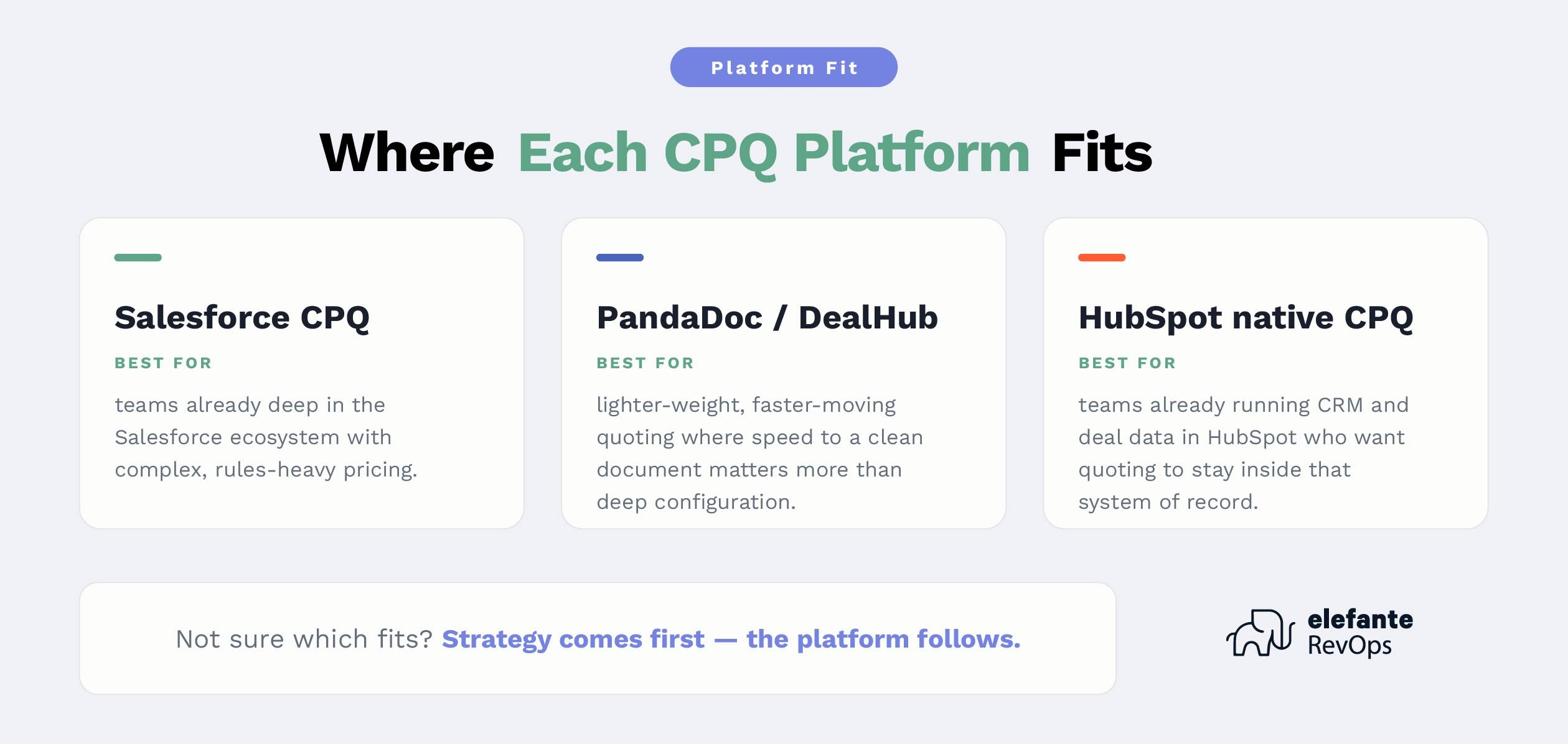
Salesforce CPQ suits teams that are already deep in the Salesforce ecosystem with complex, rules-heavy pricing that justifies its configuration overhead.
PandaDoc and DealHub are common fits for lighter-weight, faster-moving quoting needs where speed to a clean document matters more than deep configuration.
HubSpot's native CPQ, the AI-assisted Quotes tool inside Revenue Hub (formerly Commerce Hub, renamed in June 2026) on Revenue Hub Professional or Enterprise plans, has become a credible option for teams that already run their CRM and deal data in HubSpot and want quoting to stay inside that system of record instead of bolting on a separate tool.
Where to Start
If HubSpot is already your system of record, keeping quote-to-cash inside it usually follows naturally from your existing or planned HubSpot implementation services, and the CPQ choice makes itself.
If you're reading this and realizing your real problem is upstream, and that your catalog, pricing rules, and approval ownership were never defined in the first place, then the platform question is premature. That's where RevOps as a Service comes in: get the process, ownership, and data in order first, and the CPQ platform decision becomes obvious rather than agonizing.
Either way, a CPQ Assessment is how you find out which one you're dealing with, so start with a CPQ Assessment.
FAQ
What is CPQ?
CPQ stands for configure, price, quote. It's software that lets a sales team configure a product or bundle, apply the right pricing and discount rules, and generate an accurate quote without rebuilding it by hand each time. CPQ spans a spectrum, from lightweight tools built natively into a CRM to standalone platforms designed for complex, rules-heavy pricing. Which end you need depends on how complicated your pricing and approval logic actually is.
Is CPQ integration complex?
It depends on how many systems a quote has to touch, primarily CRM, billing, and contracting, and not on the CPQ platform itself. A simple price book with one approval path can be integrated in a few weeks. Multi-product bundles feeding several downstream systems take longer, because every integration adds data to validate and a handoff to test. The system count drives the timeline, so scope the integrations before you scope the project.
How does CPQ differ from traditional quoting methods?
Traditional quoting relies on spreadsheets, static templates, and pricing knowledge held in individual reps' heads. CPQ enforces your catalog, pricing, and approval logic inside one governed system, with a visible audit trail and a direct handoff to billing and contracts. The difference is trust: a CPQ quote means the same thing to sales, finance, and the customer, and you can trace exactly how any deal got priced long after it closed.